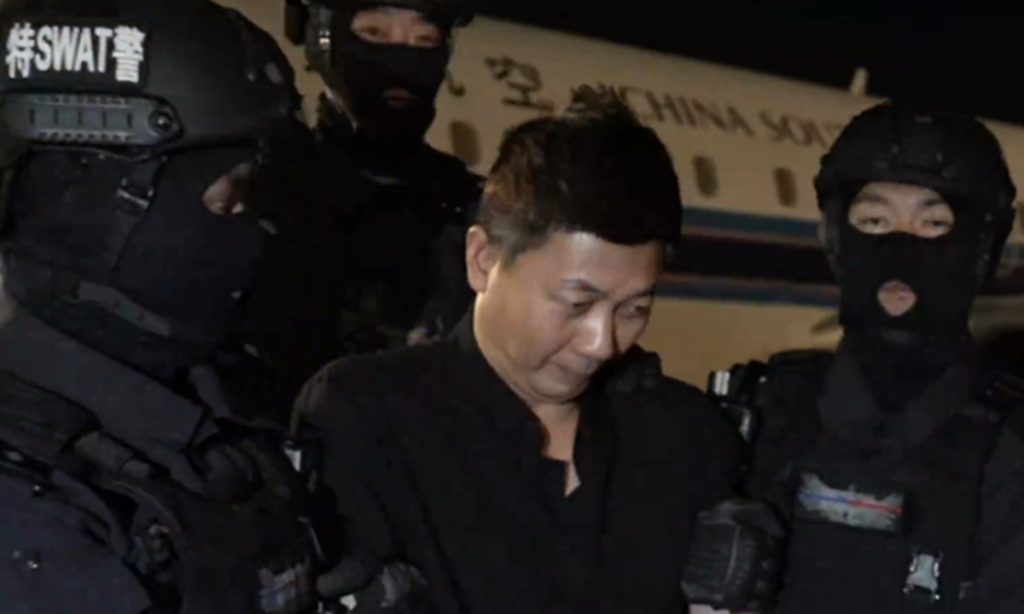
With support of relevant Cambodian authorities, a task force dispatched by China's Ministry of Public Security (MPS) successfully escorted Liu Ren - a key figure in the Chen Zhi criminal gang - back to China from Phnom Penh, Cambodia, according to the MPS on Wednesday via its official WeChat account.
This marks another significant achievement in law enforcement cooperation between China and Cambodia.
Investigations revealed that in 2016, Chen Zhi directed Liu Ren and others to establish the Jin Bei Group in Cambodia. The group operated multiple online gambling platforms, aggressively soliciting Chinese citizens to participate in online gambling, the ministry said.
Since 2020, the Jin Bei Group has operated telecom-fraud compounds in Cambodia, committing large-scale telecommunications and internet fraud involving massive sums of money. Additionally, Liu Ren is implicated in serious violent crimes, including illegal detention and intentional injury. Liu Ren has been subjected to compulsory measures in accordance with the law, and the case remains under further investigation.
Since the beginning of this year, in response to the severe situation regarding telecommunications and internet fraud targeting Chinese citizens from Cambodia, police forces from both countries have continuously deepened practical law enforcement cooperation. They have cracked down on scam compounds and criminal hideouts, apprehended key "financiers" and core members, and effectively curtailed the space for these criminal activities to survive and expand.
According to previous reports, Chen Zhi, a Chinese national and suspected ringleader of a major cross-border gambling and telecom fraud criminal syndicate, was escorted from Phnom Penh, Cambodia, back to China in January.
According to the MPS, to date, Cambodia has repatriated over 20,000 individuals involved in fraud, as well as multiple suspects wanted for homicide, to China. The MPS has mobilized public security agencies in more than ten provinces and municipalities—including Shanxi, Shandong, Hunan, Chongqing, Sichuan, Guizhou, and Gansu—to fully engage in the investigation and prosecution of these cases.
A spokesperson for the ministry stated that public security agencies will maintain a high-pressure crackdown on transnational telecommunications and internet fraud.
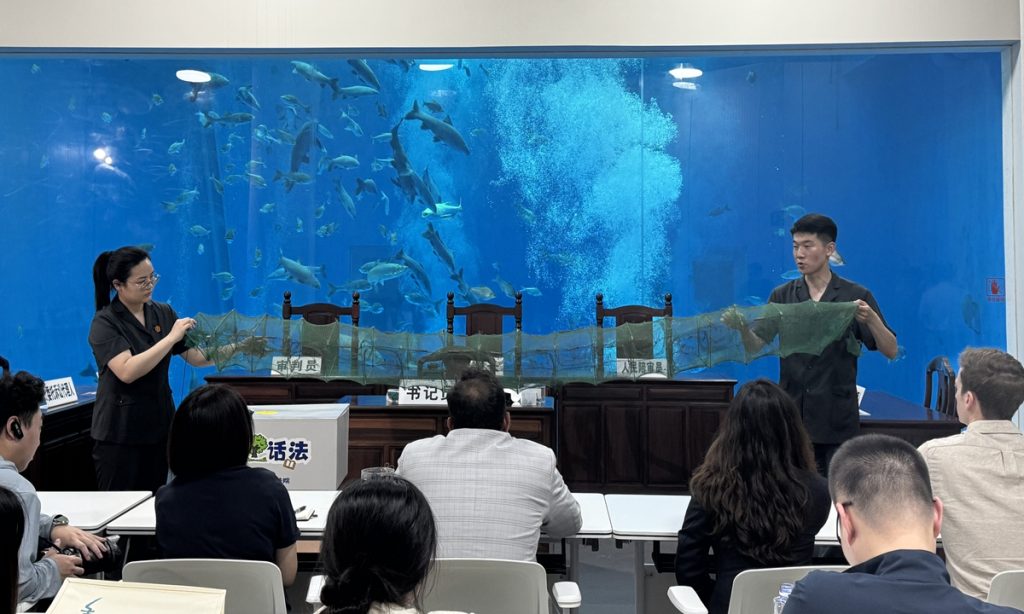
This court was unlike any courtroom most visitors would expect. Located on Shanghai's eco-island of Chongming, the circuit court features a massive aquarium behind the judges' bench, where schools of fish drift silently beyond the glass. Visitors can watch aquatic life swimming in the background while learning about cases involving wildlife and environmental protection.
On Wednesday, members of a legal observation group, including both Chinese and foreign guests, took part in a "blind box" challenge in the circuit court, drawing cards depicting different fishing tools and trying to determine whether they are legal under Chinese law. After each guess, a guide explained how the tool is used and whether its use is permitted by law.
The event was part of a program organized by the Shanghai High People's Court to showcase China's development of the rule of law. On Wednesday, members of a legal observation group visited the circuit court, where a judge from the Chongming court said the visit provided an opportunity to highlight the court's environmental adjudication efforts and showcases how specialized judicial practices are helping protect the ecosystem at the Yangtze River estuary.
The guests were first introduced to the ecological diversity of the Yangtze River through a series of aquariums outside the circuit court housing Chinese sturgeon - a nationally protected first-class aquatic species and one of the Yangtze River's flagship species - as well as other aquatic creatures.
The exhibition hall also features specimens of extinct animals as well as a number of rare species. Alongside them are displays detailing related court cases, helping visitors understand both the environmental damage caused by threats to biodiversity and the legal consequences faced by those responsible.
Later, the legal observers were introduced to the number of environmental protection cases the Chongming court has handled as this year marks both the 10th anniversary of building of Chongming's world-class eco-island and a decade of specialized environmental adjudication by the Chongming court.
The Chongming court has handled more than 2,300 environmental cases over the past ten years, including landmark cases involving the illegal killing of Chinese sturgeon, unlawful occupation of farmland and ecological restoration along the Yangtze estuary.
Court officials said the declining number of environmental cases in recent years reflects growing public awareness of environmental protection and improved ecological governance in the region.
One court official explained that the establishment of the circuit court brought environmental justice closer to where ecological crimes occur. Because many environmental violations, such as illegal fishing and poaching, take place in wetlands, forests and nearby waters, the court occasionally holds hearings at the scene of the offenses and invites local residents and fishermen to observe the proceedings.
The aim is not only to facilitate trials but also to raise public awareness of environmental protection, the official said. In addition to hearings, the site serves as a public education center, featuring exhibitions of environmental cases to help visitors understand the ecological damage caused by environmental crimes and the legal consequences for those responsible.
The foreign guests who participated in this activity were amazed by China's unique way of combining education with legal process.
"The beauty of this exhibition is that it is a good initiative for disseminating knowledge. We saw technical data on nature conservation here. We also saw reports on the cases that have been tried by the Chongming court so far. It is an important asset for environmental education. This is a trend in which China is leading the world," Douglas de Castro, a professor of international law at the School of Law of Lanzhou University, told the Global Times.
"It was very interesting because there was a combination of the theory and practice of law, which is very important for environmental protection," he noted.
"What impressed me is that the courts here are thinking beyond fines, jail sentences and other forms of punishment. They are also asking: How can we restore what has been taken away from nature? That's where things become creative, and I found that very enlightening," said Cameron Andersen, an Australian TV presenter.
"The judges are not simply thinking, 'We need to put this person in jail.' They are also thinking about nature and how to repair the damage that has been done. It was encouraging to hear that they are looking for creative ways to fix the problem, not just punish the offender," Andersen noted.
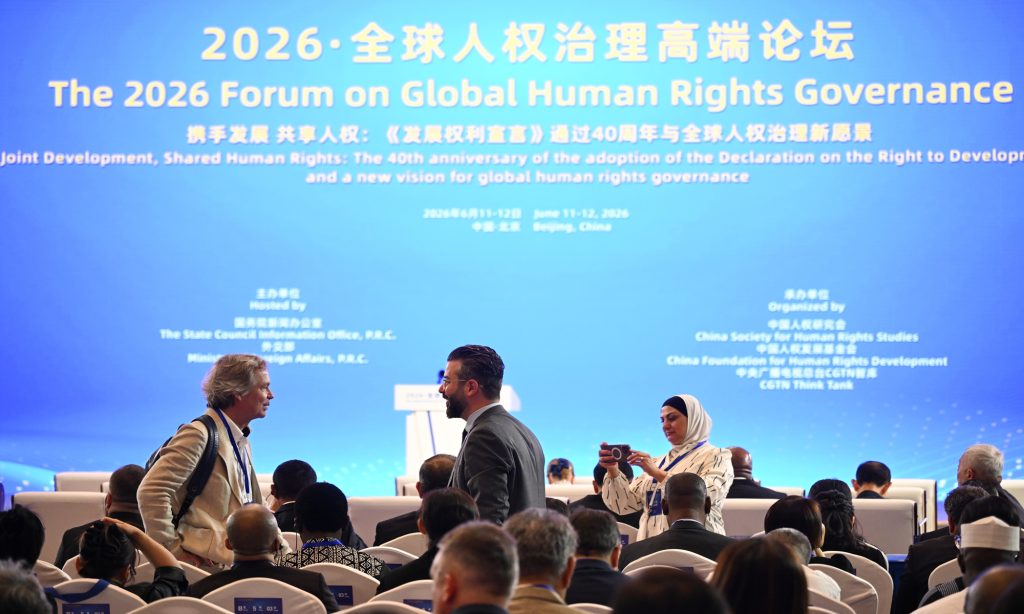
The 2026 Forum on Global Human Rights Governance opened in Beijing on Thursday, bringing together hundreds of officials, experts and representatives from around the world to discuss the role of development in advancing human rights.
The two-day forum is themed "Joint Development, Shared Human Rights: The 40th Anniversary of the Adoption of the Declaration on the Right to Development and a New Vision for Global Human Rights Governance". Over 400 participants from over 100 countries and international organizations, including the United Nations, attended the forum, the Xinhua News Agency reported.
The forum also released the National Human Rights Action Plan of China (2026-30), which outlines China's work to protect human rights in the next five years, per Xinhua.
The forum is jointly hosted by the Information Office of the State Council and the Ministry of Foreign Affairs.
With the effective implementation of its objectives and tasks, the country achieved remarkable progress in human rights protection, providing much-needed stability and certainty for global human rights development, the latest action plan said. This viewpoint also found clear echoes in remarks made by forum attendees.
Former Iraqi president Abdul Latif Jamal Rashid said during his speech that China has made tangible contributions to energy, infrastructure and many other projects in Iraq, adding that they are "contributions that we highly appreciate."
Marcella Favretto, Acting Chief of the Development, Economic, Social and Cultural Rights Branch of Office of the United Nations High Commissioner for Human Rights, said that resolutions on economic, social and cultural rights and on advancing human rights through development, spearheaded and promoted by China, have helped countries across the world better meet the growing demand for capacity-building and technical assistance.
Standing out among academics and experts was a special speaker: Luogu Youge, Party Secretary of Sanhe Village, Liangshan Yi Autonomous Prefecture, Southwest China's Sichuan Province and director of the village committee. He shared vivid personal stories to illustrate how the country's support helped his village shake off poverty.
He said that the village's per capita net income for people lifted out of poverty reached 21,933 yuan ($3,237) in 2025, up over 15,000 yuan from 2018. "When everyone has a job, every family has a sustainable livelihood, and people thrive through their own hard work — that is the most tangible human right," he said.
Whereas Western conceptions of human rights tend to focus narrowly on civil and political rights while neglecting the rights to livelihood and development, China has politically recognized that poverty eradication is a core human right, said the forum's guest speaker Zhang Weiwei, dean of the China Institute at Fudan University.
"Giving people access to health, education, basic necessities for their existence, and giving them opportunities as well as the freedom to explore and develop their talents and entrepreneurship - I think those are very key takeaways of China's development in human rights," Robert M. Persaud, Foreign Secretary, Ministry of Foreign Affairs and International Cooperation of the Co-operative Republic of Guyana, told the Global Times on Thursday.
While listening to speeches and interviewing participants, Global Times reporters also noticed that attendees paid attention to human rights issues in war-torn regions and denounced certain Western nations for politicizing human rights.
In his address, Rashid called for Gaza's children to be granted the right to education and a safe life, Gaza's doctors to be allowed to perform their duties, and the people of Gaza to live with dignity.
Agnes Oswaha, undersecretary at the Ministry of Foreign Affairs and International Cooperation, South Sudan, said that her country has long endured targeted sanctions, adding that multiple hurdles have prevented the country's rich natural resources from being translated into driving forces, and such practices are unfair.
"Unlike those Western countries, China has reached out to help us develop," Oswaha told the Global Times. Citing the story of local women learning to grow crops, Oswaha illustrated how China has helped them become productive members of society. The skills they acquired have boosted women's personal development, she said, "This is the fundamental path to advancing human rights."
Zhang said at the forum that China's practice has provided the Global South and the world at large with valuable approaches, steering global human rights governance toward a more equitable, more rational, and more sustainable trajectory.
Zhai Dayu, assistant to the Dean of the Institute for Global South Development and Human Rights in the University of International Business and Economics, also said that if a large number of less developed countries remain stuck in prolonged underdevelopment, terrorism, armed conflicts and other crises will easily breed, which will disrupt the global order. "By advancing human rights across the Global South, China is also actively safeguarding the international order," he told the Global Times.
As the forum's first day wrapped up, Global Times reporters chatted with a senior scholar, who recalled that when the UN adopted the Declaration on the Right to Development 40 years ago, he had just started his career in human rights research. Today, he joins fellow academics of diverse backgrounds in Beijing to explore ways to advance the right to development.
Just as the scholar's research deepened over four decades, so has the cause of human rights. An original vision then, it is now rooted worldwide with tangible gains for all.
An explosion occurred at a street-facing shop on Friday in northeast China's Liaoning Province, leaving two people dead and 13 others slightly injured, according to local fire authorities.
The blast, caused by a suspected liquefied gas cylinder leak, took place at 6:42 a.m. at the shop in a residential building in Benxi City. The shop covers about 35 square meters.
The injured have been sent to hospital for treatment. The cause of the accident is under investigation.
The US side has doubled down on its blockade and sanctions on Cuba, going so far as to add Cuban leaders to its sanction list. That once again reveals the US hegemonic and domineering behavior and bullying practices. China firmly opposes it, the Chinese Foreign Ministry spokesperson said on Friday in response to a question about US’ sanctions on Cuban President Miguel Diaz-Canel and some affiliated people and entities, including Diaz-Canel’s wife and stepson and Cuban leader Raúl Castro’s son and grandson.
A stable Cuba is what the international community wants to see, and any attempt from the US to destabilize Cuba will eventually backfire, the spokesperson said.
In response to the US’ sanctions, Cuban President Diaz-Canel said that these measures are aimed at reinforcing the blockade. Cuba will firmly stand against the imperial aggression. Cuban foreign ministry said that it is a ruthless act of economic aggression, and Washington could seek to use it as justification for more dangerous actions, including military aggression against Cuba.
We urge the US to immediately stop its blockade and any other forms of coercion and pressuring against Cuba, and stop infringing upon Cuban people’s right to survive and thrive. China will, as always, firmly support Cuba in safeguarding its national sovereignty and security and opposing external interference, the spokesperson added.
General Secretary of the Lao People's Revolutionary Party Central Committee and Lao President Thongloun Sisoulith arrived in Hangzhou, capital of east China's Zhejiang Province, on Tuesday for a five-day state visit.
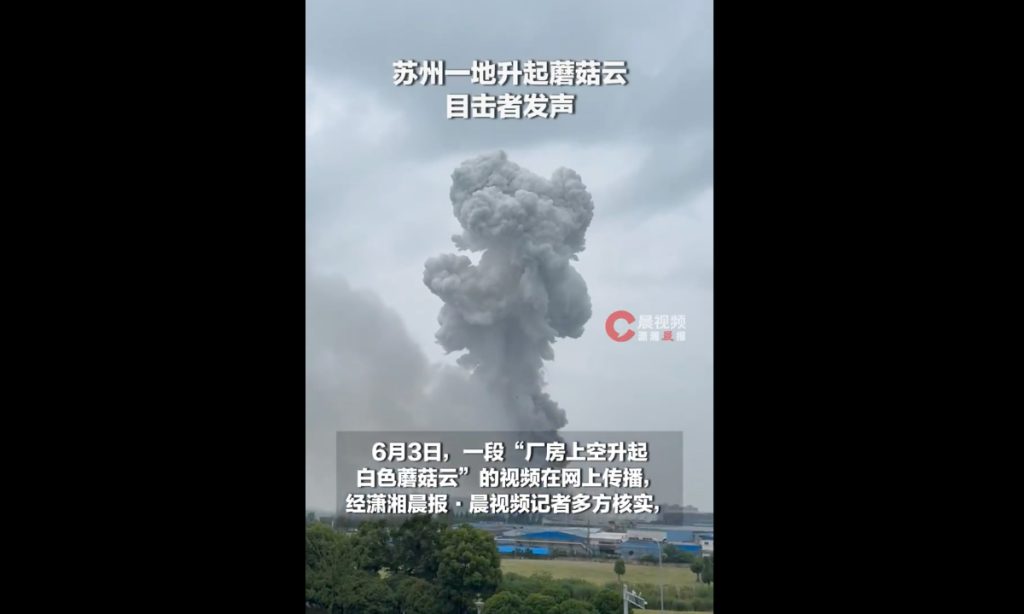
Authorities in Luzhi township of Suzhou, East China’s Jiangsu Province, said a fire broke out at a scrap recycling warehouse around noon on Wednesday. The blaze was extinguished without causing environmental pollution, and two people who suffered burns were hospitalized with non-life-threatening injuries, per the authorities.
Prior to the statement, videos circulating online show a white mushroom cloud rising above the facility, with explosions heard by witnesses before the white mushroom cloud, according to media including Dahe Daily affiliated with Henan Daily.
The local emergency management bureau confirmed with Dahe Daily that relevant departments were handling the incident after the explosions.
According to media reports, there were two explosions heard. A witness surnamed Jiang said the fire started at 10 am. The first explosions occurred between 1:30-2:00 pm and the second at around 3:20 pm. A white mushroom cloud could be seen rising from the site, Xiaoxiang Morning Post reported.
Jiang’s workplace was only a few dozen meters from the affected factory. The blast wave shattered nearby windows and brought down parts of the company's aging ceiling. The witness experienced ringing in the ears from the shock wave generated by the explosion, but did not smell any unusual odors because of the wind direction at the workplace, according to Xiaoxiang Morning Post.
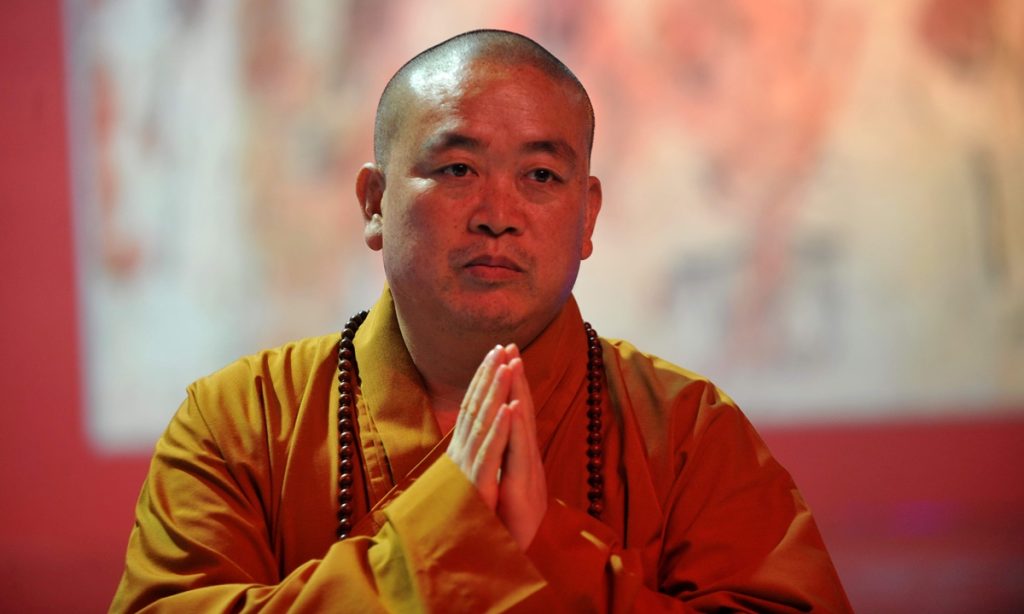
Former abbot of the renowned Shaolin Temple Shi Yongxin, originally named Liu Yingcheng, was sentenced on Friday to 24 years in prison and fined 3.5 million yuan ($488,050) for committing the crimes of occupational embezzlement, fund misappropriation, bribery as a non-state employee, and offering bribes, China Central Television (CCTV) News reported.
This case was publicly pronounced by the Intermediate People's Court of Xinxiang City in Central China's Henan Province. The Procuratorate found through trial that the defendant Liu, while serving as the abbot of Shaolin Temple and president of the Shaolin charity and welfare foundation, abused his official authority.
Between 2003 and 2025, Liu illegally embezzled over 131 million yuan of institutional assets either alone or in complicity with others. From 2012 to 2022, he misappropriated more than 151 million yuan of institutional funds for personal use and failed to repay the money within the statutory three-month period.
Starting in July 2006, Liu rendered assistance to others in undertaking construction projects and related business operations for Shaolin Temple, in return for which he illicitly accepted assets worth a total of over 11.63 million yuan.
From 1995 to 2022, to seek improper gains, Liu also offered bribes totaling more than 5.67 million yuan to state officials.
The Procuratorate ruled that Liu's conduct constituted the crimes of occupational embezzlement, fund misappropriation, bribery committed by non-state functionaries, and bribery of state functionaries.
Given the exceptionally huge sums implicated in Liu's crimes, as well as the especially aggravated circumstances surrounding his bribery offences, the protracted duration of his criminal acts, grave consequences and damaging social fallout, the Procuratorate sentenced him in accordance with the law to 24 years in jail and a fine of 3.5 million yuan, per CCTV News.
Upon the pronouncement of the verdict, Liu pleaded guilty in court and stated he would not lodge an appeal.
The Buddhist Association of China on Friday evening issued a statement on its official website stating that it believes Liu's sentencing was entirely self‑inflicted. This ruling embodies the principle that all are equal before the law and serves as a stern warning for members in Buddhist circles, read the statement.
The Procuratorate announced on March 20, 2026 that it has filed public charges against Liu, the Xinhua News Agency reported, citing sources at the procuratorate. Earlier on July 27, 2025, the Shaolin temple management office announced in a statement that Liu is under a joint investigation by several departments.
During an unannounced visit on December 14, 2025, to Shaolin Temple, Liu Ning, secretary of the Communist Party of China Henan Provincial Committee, called on religious figures to take the lead in abiding by laws and regulations and strictly observing religious discipline, continuously enhance their spiritual cultivation, properly handle the relationship between Shaolin Temple and Shaolin culture, clarify the boundaries between Shaolin Temple, the Songshan Mountain scenic area, and cultural and tourism development, return to the true essence of religion, and safeguard the reputation and image of Shaolin Temple, Henan Daily reported.
Chinese President Xi Jinping and other Party and state leaders attended a ceremony to present flower baskets to fallen heroes at Tian'anmen Square in central Beijing on Monday.
Chinese President Xi Jinping on Sunday presented medals to recipients of the national medals and honorary titles, the highest state honors, ahead of the 75th founding anniversary of the People's Republic of China.
Xi, also general secretary of the Communist Party of China Central Committee and chairman of the Central Military Commission, conferred the highest state honors at the Great Hall of the People in Beijing.