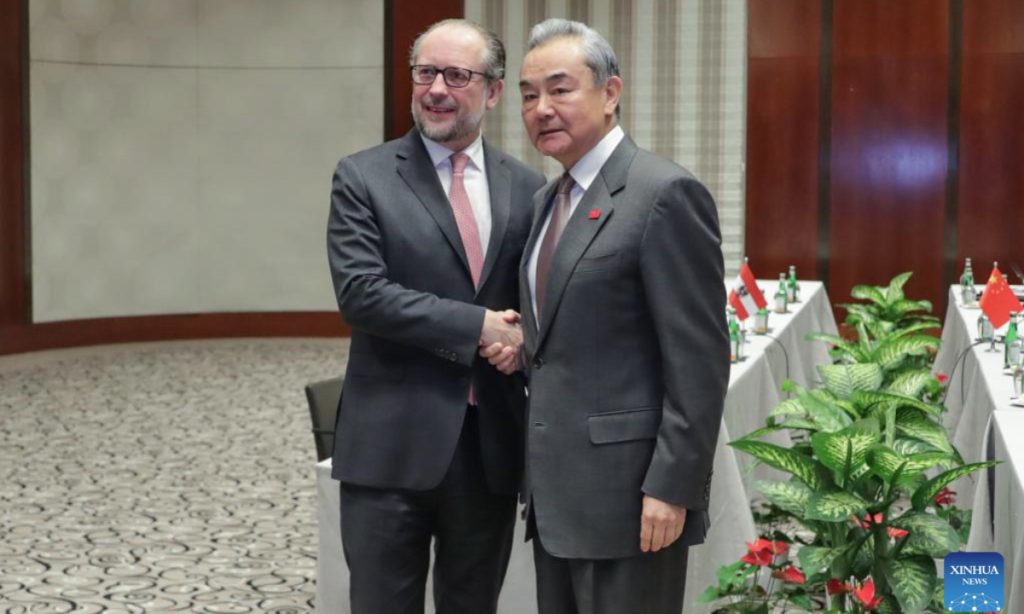
China is ready to work with Austria to jointly voice support for upholding multilateralism, maintaining the authority of the United Nations, defending the international rule of law and rejecting unilateral bullying, Chinese Foreign Minister Wang Yi said here on Saturday.
Wang, also a member of the Political Bureau of the Communist Party of China Central Committee, made the remarks when meeting with Austrian interim Chancellor and Foreign Minister Alexander Schallenberg on the sidelines of the Munich Security Conference.
Noting that the world currently faces overlapping security challenges and economic risks as well as factors of instability and uncertainty, Wang said that the international community is concerned about division and confrontation while yearning for peace and stability.
Calling the focus of this year's Munich Security Conference on multipolarization timely, Wang said China's original aspirations remain unchanged, which conforms to the trend of peaceful development and consistently plays a positive role in a changing world.
Wang noted that Austria, as a permanently neutral country, has long played the role of a bridge-builder and mediator in international affairs.
China welcomes Austria to seize new opportunities brought by China's development, deepen mutually beneficial cooperation, and advance China-Austria relations to continue leading China-EU relations, he said.
As this year marks the 50th anniversary of diplomatic relations between China and the EU, China stands ready to work with EU countries, including Austria, to invigorate China-EU relations and drive progress in the next 50 years, he added.
Schallenberg, for his part, said that Austria and China respect each other and have conducted close cooperation on bilateral and multilateral issues.
Austria cherishes its relations with China and is ready to strengthen dialogue and cooperation with China, Schallenberg said.
Decoupling and the severing of industrial and supply chains do not conform to the common interests of all parties; instead, open cooperation is key to achieving development and prosperity, he added.
Austria appreciates China's adherence to multilateralism and is willing to work with China to uphold the purposes and principles of the UN Charter and defend the post-World War II international order, he said, adding that Austria highly values China's influence as a major country and hopes China will apply Eastern wisdom to play an important role in promoting peace.
The two sides also exchanged views on the situation in the Middle East and other issues.
European leaders are gathering on Monday for an emergency summit to discuss the Ukraine crisis, amid a deepening breach with Washington and growing concerns that the Trump administration could leave Brussels out of any talks on ending Russia-Ukraine conflict.
The US' possible sidelining of Europe highlights a major divergence in their security interests, Chinese experts said.
The Russia-Ukraine conflict will become more complex, they predicted. While fighting continues on the frontline, the conflict will become a diplomatic maneuver among not only the two parties that are directly involved, but also the US and Europe, they said.
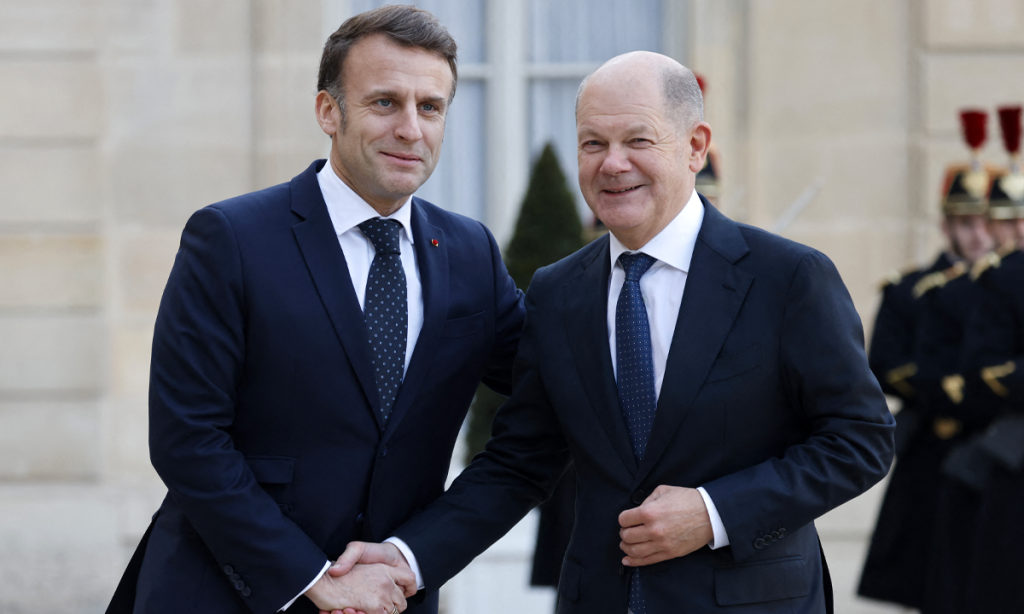
On Sunday, French presidency said French President Emmanuel Macron called for the "consultation talks" and that they would address the tumultuous change in the US approach to Ukraine and the attendant risks to the security of the European continent, Reuters reported.
The meeting will involve the heads of government of Germany, the UK, Italy, Poland, Spain, the Netherlands and Denmark, as well as the President of the European Council, the President of the European Commission and the Secretary General of NATO, according to CNN.
The emergency summit comes after US President Donald Trump stunned European allies in NATO and Ukraine last week when he announced he had held a call with Russian President Vladimir Putin without consulting with them and would start a peace process.
US Vice President JD Vance sent another round of shockwaves around the continent during his speech at Munich Security Conference on Friday, where he reprimanded European leaders, telling them that the biggest threat to their security was "from within," pointing to what he claimed was their suppression of free speech and refusal to work with hard-right parties in government, CNN reported.
Trump's Ukraine envoy Keith Kellogg jolted Europe further on Saturday when he said the European governments' positions would be taken into consideration, but won't be participants, in the peace talks, according to CNN.
"Europe has been so busy recently dealing with these multiple blows that the US dealt to them, and this summit will try to digest these disturbing developments. The immediate priority for Europe is to secure a seat at the negotiating table for the Russia-Ukraine conflict," Cui Hongjian, professor of the Academy of Regional and Global Governance at Beijing Foreign Studies University, told the Global Times on Monday.
"Although the drawing of the European geo-security borders is particularly important to Europe, the US wouldn't want the Europeans there to affect the interests of the US," Yang Xiyu, a senior research fellow at the China Institute of International Studies, told Global Times.
However, it became evident over the weekend that there were also contrasting approaches within the Trump administration. US Secretary of State Marco Rubio insisted on Sunday that Ukraine and Europe "would have to be involved" in any meaningful talks over Ukraine, reported the Guardian.
Cui said the mixed signals from Washington could be part of a broader strategy: by releasing seemingly chaotic information, the White House may be testing the reactions of various parties, with the ultimate goal of identifying a solution that it deems most suited to its interests.
UK Prime Minister Keir Starmer called the summit a "once-in-a-generation moment" for national security, and the UK would "work to ensure we keep the US and Europe together", adding the two could not "allow any divisions in the alliance to distract" from "external enemies," BBC reported on Saturday.
On Sunday night, Starmer told the Telegraph he was prepared to put British troops on the ground in Ukraine to safeguard peace. Sweden would also consider contributing to post-war peacekeeping forces in Ukraine, Prime Minister Ulf Kristersson said on Monday, per Reuters.
Yang believes that the US' potentially shutting out Europe in handling the Russia-Ukraine conflict suggests the emergence of a major divergence between the US and Europe on European security interests, which will bring about a drastic change in the structure of the transatlantic alliance. "This is a major step in the practice of 'American First' in Trump's foreign policy and will set a precedent of the US possibly abandoning Europe when their interests collide. Europe will now have to think seriously about its strategic autonomy," Yang told the Global Times.
Ukrainian President Volodymyr Zelensky has told his aides to reject the Trump administration's proposal that would grant the US 50 percent of Ukraine's rare earth minerals, NBC News reported on Monday, citing Ukrainian official close to matter.
White House National Security Council spokesman Brian Hughes called the Ukrainian President's refusal "short-sighted," AP reported. He added that the White House believes that "binding economic ties with the United States will be the best guarantee against future aggression and an integral part of lasting peace".
Cui said there is a clear disagreement between parties on what peace stands for and what the costs are. What's more, the battle will continue as both sides accumulate bargaining chips for the negotiations.
"The situation ahead could become even more complex: with fighting continuing at the front, there will be a diplomatic maneuver involving four parties - the US, Russia, Europe, and Ukraine - playing out behind the scenes," Cui said.
China supports all efforts dedicated to peace and expects a fair, lasting, and binding peace agreement accepted by all parties concerned, Chinese Foreign Minister Wang Yi said on Saturday while meeting with his Ukrainian counterpart Andrii Sybiha at the latter's request on the sidelines of the Munich Security Conference.
China supports all endeavors conducive to peace and backs Europe in playing a significant role in the peace negotiation process, Wang told Kaja Kallas, the high representative for foreign affairs and security policy of the European Commission.
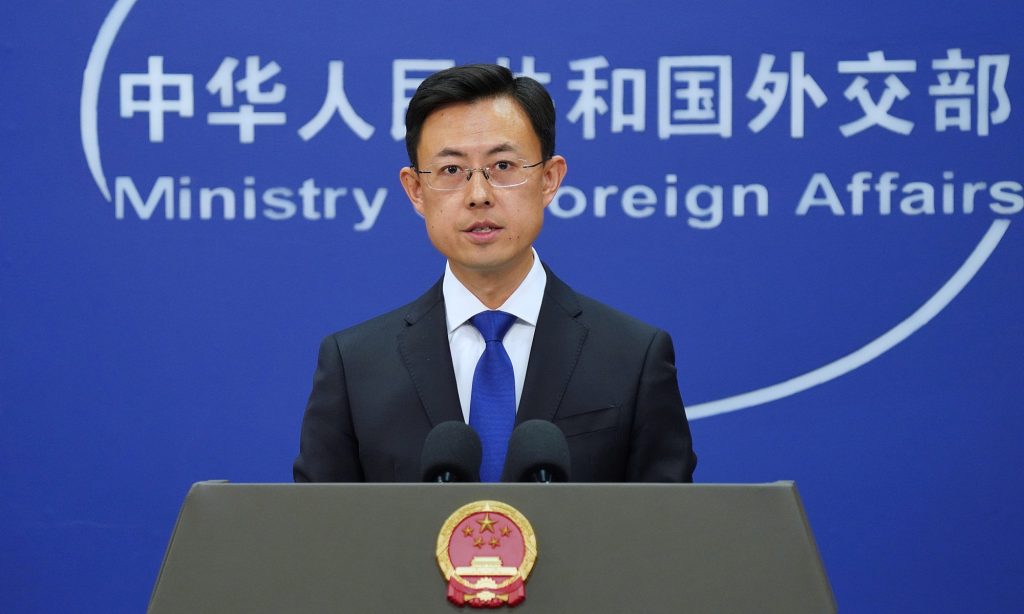
Responding to media inquiry on what drives China's desire to now align more closely with the European Union and how does new uncertainty in transatlantic relations between the EU and the US affect China, Guo Jiakun, Chinese Foreign Ministry spokesperson told a regular press conference on Monday that "as we speak, unilateralism and protectionism are rising, and uncertainties and destabilizing factors are intertwining with each other. The international community aspires for peace and stability, wants a sound and steady China-EU relationship, and expects China and the EU to play a constructive role in this changing world more than ever."
With China's population of seniors over 60 surpassing 300 million, ensuring a happy and fulfilling life for all elderly individuals has become a pressing concern for both families and the nation. How can the new generation of seniors in China break away from traditional norms and embrace a different lifestyle, supported by AI technology, multiculturalism, and an elder-friendly society?
The series of "Old Age, New Trends" will explore emerging trends in the silver economy, the creative social norms among senior citizens, and innovative eldercare services. It will examine the opportunities and challenges presented by an aging society, highlighting the diverse lifestyles of seniors and the booming eldercare industry in China. Beneath these new trends lies a reflection of Chinese modernization, which aims to provide more secure systems and dignified lives for its senior population. "He is not my type, and I'm just being very honest!" "You want someone good-looking? Do you believe good-looking people are looking for you?" "I like you, but you live on the seventh floor, I can't climb that high!" These exchanges, which left younger viewers laughing hysterically, were unscripted genuine moments, including the unfiltered reactions of senior matchmaking TV show participants in past seasons.
In recent years, a prominent trend has emerged in China: Senior dating shows have captured the hearts of many young audiences, becoming one of the most popular genres on television. On these vibrant stages, elderly gentlemen unabashedly express their desires to female contestants, proudly showcasing the wealth they have amassed over their lifetimes, while the mature women bravely choose and reject suitors without compromising themselves. In a market that prioritizes "quick matches," there is little room for hesitation or pretense. These shows have soared in ratings, resonating with younger audiences who find refreshing honesty in the candidness of their elders.
Gone are the stereotypes of reserved, hesitant seniors. Instead, these weathered individuals communicate their needs with striking clarity, shattering preconceived notions of how older adults "should" behave. Viral moments from these programs have flooded the internet, spawning memes and catchphrases that dominate social media.
The rapidly aging population in China means that senior citizens are no longer on the fringes of society. In the face of the "silver tsunami," every aspect of their needs deserves attention.
The growing popularity of matchmaking programs for senior reflects a broader cultural shift, as the silver-haired demographic - particularly those born in the 1960s and 1970s - emerges as a vibrant and engaged segment of society. No longer relegated to the sidelines, some of them demand for the recognition of their emotional and romantic needs. As the senior population continues to grow, these individuals' quality of life and desire for companionship have become focal points of social discussion.
This shift is part of a larger movement in China toward creating an senior-friendly society - one that is inclusive, secure, and considerate, reflecting the values of modernization while embracing the complexities of aging.
Unafraid to voice their affection
As the renowned Chinese literary scholar and writer Qian Zhongshu once remarked, "When the elderly fall in love, it's like an old house catching fire - there's no saving it." In the blazing twilight romances of this generation, young people have come to realize a truth: The age of 50 and beyond is still the best time to chase love.
Take "Yuan Lai Bu Wan" (It's Never Too Late for Love), a senior dating show broadcast on Jilin Television that has been on air for nearly a decade, as an example. Some clips from the program have garnered over 100 million views online, becoming a viral sensation among younger netizens, The Paper reported. In the programs, the senior participants skip the pretense and dive straight into practical matters: Housing, social security, retirement plans, and even their physical health. Their concerns and needs are laid bare with a candor that often surprises younger audiences.
In one episode, Wang Chuan, a retiree who is over 60 with a car, a house, and an annual income of over 200,000 yuan ($27,474), found himself flustered by a female guest's blunt questioning. She zeroed in on whether his diabetes would affect his physiological functions, or more bluntly, sexual function, stating matter-of-factly, "[Sexual function] is like a smartphone versus a basic phone. Whether I use it is my choice, but the function has to be there."
The Global Times noted that over 20 silver-haired dating shows have aired on Chinese mainstream television channels, some of which have run for more than a decade. The long-overlooked romantic needs of the senior citizens are now being partially addressed through these programs, while the content and commercial opportunities they generate are attracting industry players to join the fray.
These programs, brimming with witty one-liners and memorable moments, have become beloved "cyber skits" for online audiences.
Take the documentary "Qian Lang" (Front Wave) as an example. One of its protagonists, a retired "auntie" surnamed Jin, is a Chinese woman who wears a qipao, enjoys planting flowers, and loves Coca-Cola. She dons heeled shoes for hikes with her suitors and even dances with them when the mood strikes. Young viewers have commented, "Auntie Jin is living the dream love life I've always wanted."
"In another TV program, 'Talking to Strangers,' the focus is on the matchmaking corner of Beijing's Changpu River Park, where some seniors are refreshingly direct: if they like someone, they invite them to dinner that very same day, and if the feeling is strong, some would move in a short time.
A 55-year-old candidate, Li, is a fashion icon at the park with a penchant for floral shirts, sun hats, and sunglasses. He explained this bold and efficient approach to dating in the program: "At our age, time is precious. There's no room for shyness or beating around the bush."
"It is so glad to see these elderly women are taking the reins, seeking partners who are handsome, healthy, and capable of bringing them joy - no longer willing to silently serve an entire household," a netizen commented under the TV program.
Zhang Qiliang, a 31-year-old documentary producer, once filmed at a senior matchmaking corner in Beijing. "In the past, many viewed seniors discussing sex as undignified. To maintain the authority of elders and the dignity of the family, seniors were often desexualized. But today, with greater societal acceptance of diverse cultures and relationship norms, we're glad to see these mature adults coming out of hiding. They're no longer ashamed of their desires but are openly showcasing their lives. They're deconstructing their views on love and marriage with remarkable honesty," he said. Behind this desire, he added, lies a yearning for vitality and a refusal to succumb to loneliness.
Zhang shared with the Global Times an encounter with a senior woman's solitude that impressed him. "An 80-year-old auntie, whose peers had all passed away, lived alone and only talked to an AI assistant on her TV. When the AI assistant on the TV asked, 'Have you eaten?' she would reply, 'I had this today.' Her loneliness and the risks of living alone became the impetus for our documentary," said Zhang.
"The challenges faced by senior individuals living alone are undeniable as China faces soaring number of elderly. However, we still wish showcase another facet of China's senior population - one that is vibrant and full of exploration. Our goal is to inspire more seniors to explore socializing and entertainment opportunities," Zhang noted.
Do children support their parents in their pursuit of love? It was also a hot topic of discussion on the matchmaking TV shows. Zhang told the Global Times that during the filming process, he encountered children accompanying their parents to matchmaking events. These children fully supported their parents' bold expressions of love and choice, especially for mothers who had few opportunities to make such decisions in their youth.
As micro dramas take off in China, some producers are also turning to feature elderly groups, with themes like "The Dominant CEO Falls for Me, a Retiree." Although controversial, this highlights the emotional needs of middle-aged and older audiences and indicates a lucrative commercial opportunity. A more loving, inclusive, and supportive society
On January 17, the National Bureau of Statistics of China announced that, by the end of 2024, the population aged 60 and above in China would reach 310.3 million, surpassing 300 million for the first time.
In January 2024, the General Office of the State Council issued guidelines on developing the silver economy to enhance the well-being of seniors, emphasizing the need to cultivate content industries such as literature, broadcasting, film, music, and short videos tailored for seniors.
In addition to popular dating shows, a wave of retirees seeking companionship has emerged on social platforms. These individuals are enthusiastic about socializing, traveling, and photography, actively embracing the internet in pursuit of a fulfilling retirement.
In July 2023, a young entrepreneur, Liu Jing, observed a significant shift in the consumption habits of the new middle-aged and senior demographic. No longer satisfied with mundane routines, they yearn to expand their horizons through diverse activities. To meet this demand, Liu established the Funclub in Beijing, offering a dynamic retirement lifestyle through a variety of social events and activities for like-minded seniors.
Weekly offerings include cultural exhibitions, hands-on AI tool workshops, traditional crafts, Chinese medicine wellness sessions, rock climbing, archery, and gourmet salons. The club promotes a vision of "forgetting age, rejecting loneliness, and ensuring a fulfilling, joyful, and healthy retirement," with over 12,000 online followers and 6,000 active participants so far, according to Liu.
Liu said that what's behind her business is the fact that China is striving to establish an senior-friendly society against the backdrop of a rapidly aging population.
The Funclub's page on Chinese social media app "RedNote," or Xiaohongshu, posts about vibrant activities post regular updates, showcasing a group of women over 50 who recently gathered to exchange flowers on Valentine's Day. Their lively expressions convey a powerful message: In a safe, comfortable, and diverse cultural environment, seniors can enjoy love and happiness on their own terms, just like the younger generation.
Chinese Foreign Ministry spokesperson responded on Tuesday to questions regarding US withdrawing from the Paris Agreement and the WHO, as well as the US President Donald Trump's claims about the Panama Canal.
In response to the White House's announcement to withdraw from the Paris Agreement on Monday, Chinese Foreign Ministry spokesperson Guo Jiakun said that China expresses concern over the US announcement.
Guo noted that climate change is a common challenge faced by all humanity, and no country can remain unaffected or isolated from its impact. China will work with all parties, upholding the concept of a community with a shared future for mankind, to actively tackle the challenges of climate change and jointly promote the global green and low-carbon transformation.
Regarding the US withdrawal from the WHO, Guo said that the WHO plays a central and coordinating role in global health governance. The role of the WHO should be strengthened, not weakened. China will continue to support the WHO in fulfilling its responsibilities, deepen international public health cooperation, enhance global health governance, and promote the construction of a community of shared health for humanity.
China's position on issues related to the Panama Canal is consistent and clear, Guo said in response to a question concerning Trump's claim that China was effectively "operating" the Panama Canal and that the US would take back the canal. "I have no additional information to share," Guo said.
In response to a question regarding US President Donald Trump's plan to impose new tariff on Chinese exports to the US, starting February 1, Chinese Foreign Ministry Spokesperson Mao Ning said on Wednesday that "We believe that there's no winner in a trade or tariff war, and we firmly uphold our national interests."
On whether China and the US have engaged in or are currently holding talks on tariff-related issues, Mao said at the daily press conference that "we stand ready to maintain communication with the US, properly handle differences, expand mutually beneficial cooperation and pursue a steady, sound and sustainable development of China-US relationship. China will also firmly defend its own interests."
According to Reuters, Trump on Tuesday vowed to hit the European Union with tariffs and said his administration was discussing a 10 percent punitive duty on Chinese imports because "fentanyl is being sent from China to the US via Mexico and Canada."
Trump voiced his latest tariff threats in remarks to reporters at the White House a day after taking office without immediately imposing tariffs as he had promised during his campaign.
Financial markets and trade groups exhaled briefly on Tuesday, but his latest comments underscored Trump's longstanding desire for broader duties and a new February 1 deadline for 25 percent tariffs against Canada and Mexico, as well as duties on China and the EU.
Trump said the EU and other countries also had troubling trade surpluses with the US. "The European Union is very, very bad to us," he said, repeating comments made on Monday.
Europe will respond to any tariffs imposed by the US president in a proportionate way, the European Union's commissioner for the economy Valdis Dombrovskis told CNBC on Wednesday. "If there is a need to defend our economic interests, we will be responding in a proportionate way," Dombrovskis told CNBC on the sidelines of the World Economic Forum in Davos, Switzerland.
Canada's Prime Minister Justin Trudeau said his country will respond "robustly" if Trump follows through with imposing tariffs on Canada, telling reporters on Tuesday that "everything is on the table," CNN reported.
"If there are unfair tariffs, we will respond robustly and we will be there to support Canadians and protect our interests," Trudeau said at the press conference in French when responding to a journalist's question, according to CNN.
Mexican President Claudia Sheinbaum emphasized on Tuesday that she will defend her nation's sovereignty and independence but also pursue dialogue with US President Trump, Reuters reported.
In her first comments following Trump's inauguration, Sheinbaum noted that some of his initial announcements closely resemble actions he took in his previous term, as she also sought to reassure Mexicans that she will strenuously defend their interests.
Prepare for impact
The US will likely keep using tariffs as a weapon to get what it wants from other members of the international community, whether its allies or other major powers, Jin Canrong, professor of school of international studies at Renmin University of China, told the Global Times on Wednesday.
The new US administration's acts are not surprising to the international community. For instance, the key EU member Germany is being prepared for the impact. According to Politico, "Germany will be the prime European target" of Trump's trade tariffs once he's in office, German Economy Minister Robert Habeck said on Saturday.
The warning by Habeck, who is the Green Party's lead candidate in Germany's February 23 election, came on the same day as a slightly more positive statement by his center-right opponent Friedrich Merz, who called Trump "very predictable," Politico reported.
Zhou Mi, a senior research fellow at the Chinese Academy of International Trade and Economic Cooperation, told the Global Times on Wednesday that what happened during Trump's first term tells that the global supply chain will be greatly impacted [if the US goes on with imposing additional tariffs]. Many countries will adjust their trade ties, and the whole global trade will be more fragmentized.
"Therefore, the new tariffs this time will cause similar damage to the stability of world trade and global supply chain. US customers and importers will pay higher price to purchase the goods from relevant countries, and the exporters of these countries will be more cautious to export goods to the US due to the increasing costs. Moreover, some countries would take tit-for-tat countermeasures against the US, so US exporters will also be impacted," Zhou noted.
CNN said in a fact check article on Monday that "In his inaugural address, Trump said, 'Instead of taxing our citizens to enrich other countries, we will tariff and tax foreign countries to enrich our citizens.' But this description of tariffs is false. Tariffs imposed by the US government are paid by US importers, not foreign countries."
Wu Xinbo, director of the Center for American Studies at Fudan University, told the Global Times on Wednesday that if the US side really imposes new tariffs, the trade ties between China and the US would experience turbulence.
Trade is the key impetus to the world economy, so if international trade gets seriously impacted by a new round of trade war or tariff war unilaterally launched by the US, then the world economy would also get impacted badly, and the fragile global recovery would be further weakened, Wu noted.
On Friday, with China’s permission, the Philippines dispatched a civilian ship to deliver living supplies to its illegally “grounded” warship at Ren’ai Jiao. The China Coast Guard (CCG) inquired about and verified it and monitored the entire process, CCG spokesperson Liu Dejun said in a statement on Friday.
“We hope the Philippine side will honor its promises and engage with China to jointly manage the maritime situation. The CCG will continue its rights-safeguarding and law enforcement activities in the Nansha Qundao, including Ren’ai Jiao and surrounding waters, in accordance with the law,” Liu said.
Whenever she works late into the night in Wuhan, central China's Hubei Province, Wu You ends up hailing an "unmanned cab," or robotaxi, via her smartphone to take her home. This futuristic way of travel has now become part of Wu's existence in this city.
"It's convenient, and the difference between these cars and regular ride-hailing services isn't that big," Wu said. "The car is clean and odorless, and offers a more private ambiance."
It is the Apollo Go service that Wu is opting to use in Wuhan. Operated by China's internet giant Baidu, this robotaxi service featured more than 400 fully driverless vehicles in Wuhan as of October 2024, covering an area of over 3,000 square km in the city. Some parts of the city even offer 24-hour testing and demonstration services.
In Wuhan, more people now share sentiments similar to Wu's. They have gradually transitioned from curiosity and concern regarding this novel mode of transportation to acceptance and appreciation of its convenience.
Wuhan is not the only city where this fresh new riding experience is available. Chinese megacities like Chongqing, Beijing, Shanghai and Guangzhou have also invested heavily in experimentation and development concerning the service, with companies focusing on robotaxis having emerged nationwide -- including Apollo Go, WeRide and Pony.ai.
The proliferation of autopilot hailing services in Chinese cities stems from the country's ever-improving governance of this sector. Over the years, a series of policies have been released to boost and regulate autonomous vehicle technology and the broader industry, including road testing, registration and traffic safety liability for autonomous vehicles.
In April 2018, three central authorities jointly launched guidelines for road testing intelligent connected vehicles. An upgraded vision was introduced in July 2021, allowing vehicles that have been proven safe and reliable by road tests to carry people and goods. This upgrade also saw testing areas expanded to include highways and urban roads.
Such policies have laid a foundation for the development of the industry -- offering clear guidelines for companies to follow.
As of August 2024, Chinese public security authorities had issued a total of 16,000 test licenses for autonomous vehicles and 32,000 kilometers of roads nationwide had been opened for autonomous vehicle testing, according to the Ministry of Public Security.
LOCAL GOVERNMENTS AND INDUSTRY SUPPORT
Guided by the top-level design of the central government, local governments have introduced corresponding policies to refine the management of this field and promote its development.
Beijing launched the country's first high-level autonomous driving demonstration zone in September 2020 -- covering 600 square kilometers and equipped with advanced intelligent infrastructure.
Currently, Beijing allows companies to offer robotaxi services on designated test routes from the demonstration zone to two of its major transportation hubs, namely Beijing South Railway Station and Beijing Daxing International Airport.
On Dec. 31, 2024, Beijing passed new regulations on autonomous vehicles, with authorities aiming to promote the sustainable, standardized and healthy development of autonomous car technology and the industry. These regulations will take effect on April 1, 2025, and cover the categories of technological innovation, infrastructure planning, road access management, safety and security, and legal responsibility.
Liu Yu, deputy general manager of Beijing Automotive Group Co., Ltd., said relevant legislation has boosted the confidence of related companies in opting for continued investment and will encourage automakers to increase investment, accelerate technological iterations, and continuously enhance the consumer experience.
According to a notice published on Dec. 30, 2024, Wuhan also approved regulations to promote the development of intelligent connected vehicles. Two guidelines forming part of this initiative provide a clear regulatory framework in terms of local practices for autonomous vehicles equipped with Conditional Driving Automation (L3) and higher systems.
Meanwhile, in the southern Chinese metropolis of Guangzhou, regulations concerning autonomous cars have been submitted to the provincial legislature.
China's metropolises have green-lighted autonomous driving promotion and laid solid cornerstones for the future operation of driverless vehicles.
ROBOTAXI DEVELOPMENT GEARING UP
The rise of autonomous vehicles has also spurred the development of robotaxis in the country.
Pony.ai, a Guangzhou-based Nasdaq-listed company offering robotaxi services, believes that with the gradual implementation of local regulations, the future policy landscape will become even more favorable for this industry.
Mo Luyi, vice president of Pony.ai, said the new policies will enable the government to exert greater oversight on autonomous driving, ensuring market fairness and supporting the industry's long-term growth.
New policies also mean that the government can implement more dimensions of supervision on autonomous driving -- which is conducive to maintaining a fair order in the market and protecting the long-term development of the industry, Mo added.
According to Pony.ai, the scale of robotaxi placement is expected to reach 100,000 vehicles by 2030, when the robotaxi share of the overall travel market will reach between about 10 percent and 20 percent.
The value of China's self-driving taxi service industry is expected to amount to 1.3 trillion yuan (about 180.83 billion U.S. dollars) by 2030, accounting for 60 percent of the country's ride-hailing market at that time, according to forecasts from global consultancy firm IHS Markit.
The Chinese public also has a positive view of this burgeoning industry. In a report published in November 2024, Bloomberg Intelligence suggested that Chinese consumers were more accepting of autonomous driving than those in the United States and Europe.
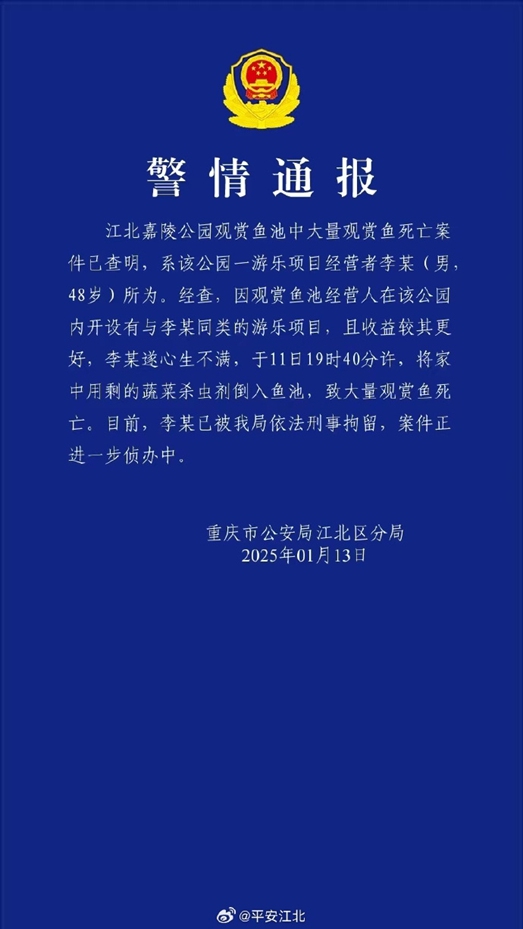
Following the death of a large number of ornamental fish on Saturday in a pond at Jialing Park in Southwest China's Chongqing Municipality, which garnered public attention in recent days, local police notified on Monday that a suspect has been criminally detained for dumping pesticide into the water due to dissatisfaction with an operator in the park whose business is more profitable than the suspect's.
According to a release by police at Jiangbei District Branch of Chongqing Municipal Public Security Bureau on Monday, a 48-year-old man surnamed Li was found to be responsible for the incident, who is an operator of a recreational project at the park.
After investigation, police discovered that the other operator of the ornamental fish pond had launched a similar amusement project in the park that was more profitable than Li's. Out of dissatisfaction, Li dumped leftover vegetable pesticide from his home into the fish pond on Saturday, leading to the death of a large number of ornamental fish.
Li has been criminally detained in line with legal procedures, and the case is under further investigation, according to the release.
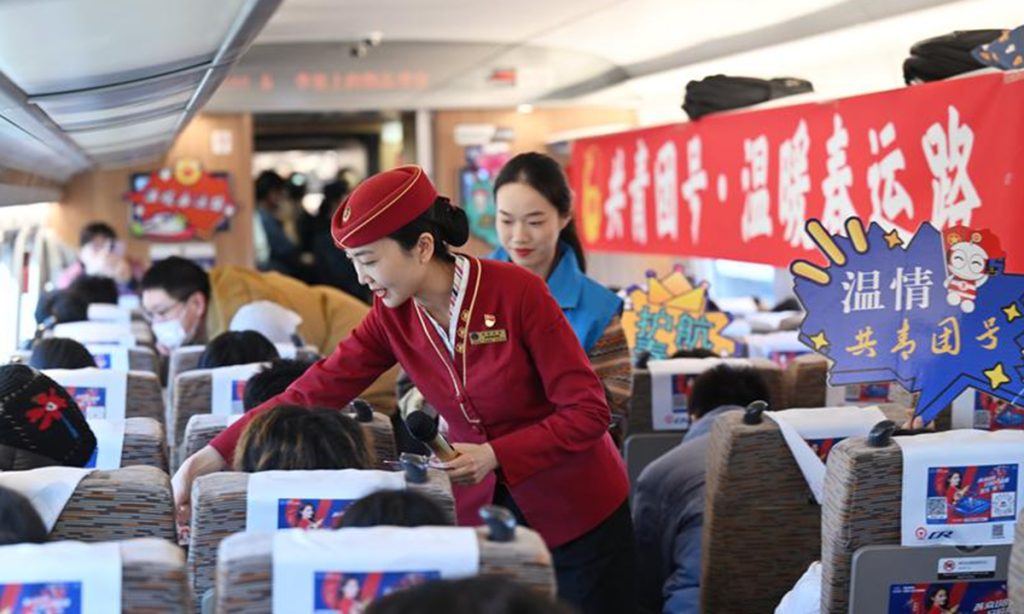
China's annual Spring Festival travel rush, also known as chunyun, officially started on Tuesday, during which a record 9 billion trips are estimated to be made during the 40-day period of festivities. On the first day of chunyun, hustles and bustles are on vivid display across the country's railway stations and airports, as millions of passengers - carrying bags filled with gifts and treats - embark on homecoming trips in an atmosphere charged with joy and the festive spirit.
As the largest human migration on the planet, chunyun is not only considered a manifestation of China's transportation prowess and technological progress, but also a barometer gauging into the dynamic of the world's second-largest economy "on the move." As such, the epic number of the Chinese population on the move underscores the massive consumption potential, analysts said, while expecting multiple holiday consumption trends to take footholds and buttress the economy to get off to a good start in 2025.
Reunion journey
China's annual Spring Festival travel rush starts at 12:02 am on Tuesday, with regular-speed passenger train K4159 leaving Beijing West Railway Station to Hefei, East China's Anhui Province. The Global Times noticed that the train was adorned with traditional decorations like paper-cuts, Chinese knots and ribbons, and a red banner "homecoming is the essence of Chinese Lunar New Year" was displayed in one of the train coaches, infusing the reunion journey with warmth and a holiday cheer.
When the Global Times paid an on-site visit to the station on early Tuesday morning, the Beijing West Railway Station was crowded with travelers who moved briskly and energetically while carrying large bags. With the train announcement echoing through the air and passengers all wearing bright smiles, the station was filled with the cheerful atmosphere of celebrating the Chinese Lunar New Year.
The Beijing Chaoyang Railway Station was also bustling with activities when the Global Times visited it on Tuesday morning. Hundreds of Chinese travelers were lining up in the station's waiting hall in an orderly manner under the guidance of railway staff members.
The Global Times also learned from staff members that this year, a range of cutting-edge technologies such as big data, cloud computing, artificial intelligence, smart system and facial recognition have been widely applied to facilitate a variety of processes during chunyun, including ticket sales, security check as well as station entry and exit.
During the stay at the Chaoyang Railway Station's waiting hall, a young boy ran into the Global Times' reporter. With palpable excitement on his face, the boy eagerly shared his joy about beginning his winter break by heading to the Harbin Ice-Snow World in Northeast China's Heilongjiang Province, which is also the world's largest ice-and-snow theme park.
His mom, a local resident surnamed Xing from Hangzhou, East China's Zhejiang Province, told the Global Times that they will soon take the train to go on a family trip in Harbin on Tuesday. "My son saw some videos of the park on social media and can't wait to play in the snow and see the ice sculptures," Xing said, adding that she ''bought the ticket a week ago.''
Regardless of being children with adorable faces, or the elderly with silver hair, the Spring Festival travel rush embodies the longing and anticipation of ordinary Chinese people for reunion after a year of hard-working, and for welcoming a more prosperous year ahead.
A 60-something security guard surnamed Li, who worked in Beijing and took the K4159 train to go back to his hometown in Anhui, told the Global Times on Tuesday that what he expects most for the reunion trip is to spend more time with his four grandsons. "My grandsons have been eagerly awaiting my return, they're always calling to ask when I will be home," Li added.
Vibrant economic activities
According to a statement China Railway sent to the Global Times on Tuesday, on the first day of the Spring Festival travel rush, the national railways are projected to deliver 10.3 million passenger trips. It is expected that during this year's Spring Festival travel period, the railway passenger volume will exceed 510 million, with an average of 12.75 million people per day, representing a 5.5 percent year-on-year increase.
China Railway will increase passenger transport capacity for the travel rush. The new railway lines that began operations in 2024, along with the 185 new Fuxing high-speed trains capable of running at speeds up to 350 kilometers per hour deployed prior to the travel rush, will effectively expand transportation capacity, the statement noted.
In terms of aviation capacity, more domestically produced C919 large passenger jets will be put into service due to the Spring Festival travel rush. And air travel during this year's travel rush is projected to exceed 90 million, also setting a new historical record.
China Eastern Airlines told the Global Times that it plans to deploy 804 passenger aircrafts, including 10 domestically produced C919 aircraft, and operate 124,000 flights during the 40-day period. Starting from January 9, Air China also put a new C919 jet operating on the flight route between Beijing and Southwest China's Chongqing Municipality, making the total air routes operating with C919 to five during the travel rush period, the Global Times learned from the Chinese carrier on Tuesday.
Wang Peng, an associate research fellow at the Beijing Academy of Social Sciences, told the Global Times on Tuesday that the large-scale movement of population pointed to vibrant economic activities, which will lead to "an explosive growth" of potential consumer demands in all fronts during the Spring Festival travel rush period, including dining, accommodation, shopping and entertainment.
This year's Spring Festival features 8-day-long holidays that start on January 28 and a substantial relaxation of China's visa-free transit policy. Additionally, it is the first travel rush since China's Spring Festival was inscribed on the Representative List of the Intangible Cultural Heritage of Humanity by UNESCO, China Railway said.
Data released by various travel platforms signaled a travel boom in the upcoming eight-day Spring Festival holidays, which analysts believe will further bolster market confidence and stimulate market entities' vitality.
In response to a question regarding trending "China travel", China's Foreign Ministry said on Tuesday that the country welcomes foreign tourists to join China's celebration of the Spring Festival, experience the joy of the Chinese Lunar New Year, feel the warmth of Chinese hospitality, and usher in an auspicious Year of the Snake.
"A robust spending spree could directly drive economic expansion and fuel industrial upgrade, therefore laying a solid foundation for the world's second-largest economy to start off in the new year of 2025," Wang noted.
Also, unlike in the past when there would be "a scarcity of tickets" due to strained transportation capacity, the country's ability to support 9 billion trips speaks volume for the growing prowess of China's transportation infrastructure, analysts added.
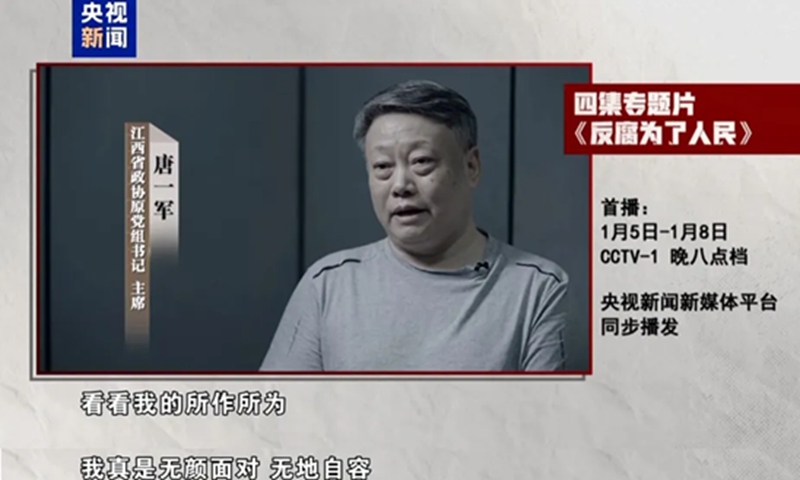
An anti-graft documentary uncovering grassroots corruption and hidden tactics through prominent cases of high-level corrupt officials began to air on Sunday, demonstrating China's commitment to fighting corruption for the people, and constantly enhancing their sense of gain, happiness and security.
The documentary will share a total of 12 cases in four episodes from Sunday to Wednesday. It was co-produced by the Publicity Department of the Central Commission for Discipline Inspection of the Communist Party of China (CPC) and the National Commission of Supervision and China Central Television (CCTV).
According to a trailer released by CCTV, Sun Zhigang, former secretary of the CPC Guizhou Provincial Committee, who has been sentenced to death with a two-year reprieve for taking bribes in October 2024, confessed that he failed the training and trust of the Party, lost sight of his bottom line and committed serious mistakes and crimes.
Sun was convicted of illegally accepting bribes worth over 813 million yuan ($114 million), either by himself or via other people, the Xinhua News Agency reported in October.
"Look at what I have done, I am so ashamed and disgraced," said Tang Yijun, a former senior political advisor in East China's Jiangxi Province, in the documentary.
Tang, former chairman of the Jiangxi Provincial Committee of the Chinese People's Political Consultative Conference (CPPCC), had taken advantage of his power to seek benefits for others in matters such as enterprise operation and listing, job promotion and legal-case handling, illegally accepting huge amounts of money and valuables in return. China's Supreme People's Procuratorate ordered the arrest of Tang for suspected bribe-taking in October 2024.
Cui Maohu, former head of the National Religious Affairs Administration, who was sentenced to 11 years in prison for accepting bribes, said in the documentary that "when you overlook small details, they can eventually grow into serious issues."
An investigation into Cui's case revealed that between 2007 and 2023, he took undue advantage of his positions to secure benefits for others in matters of project contracting, payment allocation and official appointments. In return, he illegally accepted money and property worth 10.43 million yuan, as reported by Xinhua in July 2024.
According to the trailer, Sun Shutao, formerly a senior political advisor in East China's Shandong Province, who was sentenced to life imprisonment on the charge of accepting bribes in June 2024, said that "in order to seek promotion and pursue political achievements, I inflated the GDP to such a high level, which I deeply regret it."
The court in the Northern Shanxi Province found that Sun, formerly vice chairman of the Shandong Provincial Committee of the CPPCC, had accepted bribes worth a total of over 129 million yuan between 2001 and 2023, according to Xinhua.
The trailer also featured other corrupt officials who confessed on camera, including Wang Yilin, the former chairman of the China National Petroleum Corporation, against whom public prosecution has been initiated on suspicion of bribery in November 2024.
The documentary premiered just a day before China's top disciplinary agency convenes a pivotal plenary session from Monday to Wednesday, where it will outline key priorities in the fight against corruption for the year ahead.
China's anti-corruption battle continues to roar. In 2024, it made waves in sectors such as finance, energy, healthcare and sports, while dismantling sophisticated forms of graft that sought to conceal themselves as legitimate market practices.
According to the country's top anti-corruption watchdog, 58 high-ranking officials under the supervision of the Communist Party of China Central Committee were probed last year, according to Xinhua.
The crackdown on corruption has also intensified in areas impacting the daily lives of ordinary people. A campaign launched in April 2024 saw 433,000 low-ranking officials disciplined, with 14,000 referred for prosecution, according to the Xinhua report.
New manifestations of corruption today include the emergence of innovative forms within the public finance sector and at the grassroots level. New tactics driven by advancements in digitalization are also emerged, Zhang Xixian, a professor at the Party School of the CPC Central Committee, told the Global Times on Sunday.
Understanding today's effort in fighting against corruption is crucial, as people now recognize that the country's commitment to fighting corruption is not mere rhetoric but a steadfast dedication to action, reflecting the new normal in the anti-corruption landscape, Zhang said.
On December 25, Chinese lawmakers voted to adopt a decision to amend the Supervision Law, the country's primary legislation for combating corruption. The decision, made at a session of the Standing Committee of the National People's Congress, will take effect from June 1, 2025.
This amendment aims to improve relevant systems in a targeted manner, provide a legal basis for solving practical problems, refine supervisory procedures and enrich provisions for international anti-corruption cooperation, according to a statement published by CPC CCDI and the National Commission of Supervision.
It transforms the decision-making and deployment of the CPC Central Committee on continuously deepening the reform of national supervision system into the will of the country through statutory procedures, further improves the basic legal system for combating corruption, and provides a strong guarantee for resolutely winning the protracted battle against corruption, according to the statement.