A new way to make bacteria glow could simplify TB screening

A new molecule that reveals active tuberculosis bacteria in coughed-up mucus and saliva could simplify TB diagnoses and speed up tests for detecting strains of the disease that are resistant to drugs.

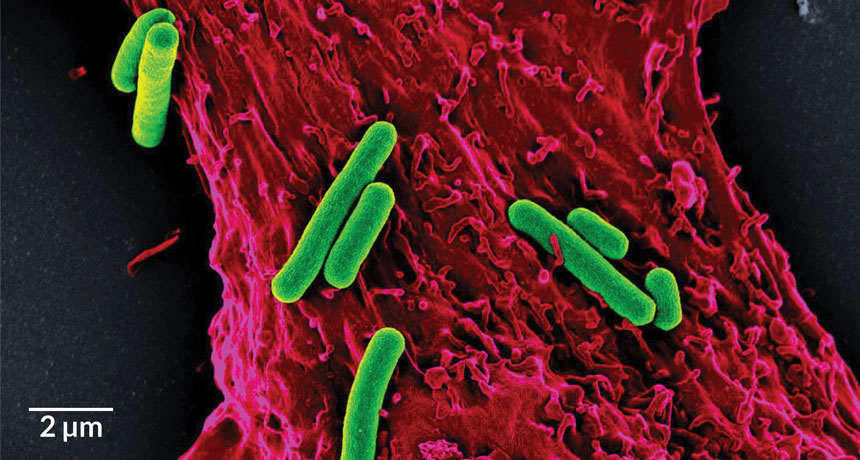
This synthetic molecule is a modified version of a sugar that TB bacteria consume to help build their cell walls. The sugar is tagged with a dye that lights up under a fluorescent microscope — but only if the dye isn’t surrounded by water. Dubbed DMN-Tre, the hybrid molecule stays dark until it enters a fatty, water-repellant layer in a TB bacterium’s cell wall, where it starts to glow, researchers report online February 28 in Science Translational Medicine.
Standard tests use dyes that stain a bunch of different bacteria, so technicians have to bleach the dye off everything except the TB cells, says Sumona Datta, a tuberculosis researcher at Imperial College London not involved in the work. But that chemical washing is time-consuming and prone to error. Since DMN-Tre only glows when it’s gobbled up by TB or one of its close relatives, the molecule could offer a simpler, more reliable diagnosis, she says.
Tuberculosis killed 1.7 million people worldwide in 2016, according to the World Health Organization. And rampant resistance to drugs is making the disease harder to fight.
Chemical biologist Carolyn Bertozzi, a Howard Hughes Medical Institute investigator at Stanford University, and colleagues tested the new molecule on mucus-saliva mixtures hacked up by 16 people with tuberculosis. The molecule flagged TB microbes in the samples after a couple of hours, and it revealed similar amounts of bacteria as the standard staining technique — without the hassle of post-dye chemical washing.

“That’s pretty impressive,” says Jianghong Rao, a chemist and radiologist at Stanford not involved in the work. But DMN-Tre needs to be tested in a larger clinical trial before being ready for prime time, he says.

The new TB screening technique may also have an edge in checking whether patients respond to treatment, says Eric Rubin, a microbiologist at Harvard University. Because the molecule only lights up when eaten by healthy, hungry TB bacteria, it won’t flag microbes that have been crippled or killed by antibiotics as typical tests do. So if there are still lots of glowing microbes in phlegm from patients treated with an antibiotic, a doctor knows to try a different drug.

While current drug-resistance tests can take weeks or months, DMN-Tre reveals how drug-treated bacteria are faring within a few hours. “That’s tremendously exciting,” says Carlton Evans, also a tuberculosis researcher at Imperial College London not involved in the study. Speedy drug-resistance tests (SN Online: 12/7/14) could help researchers predict sooner which antibiotics stand the best chance of taking down TB bacteria.

Some meteorites contain superconducting bits

LOS ANGELES — In the search for new superconductors, scientists are leaving no stone — and no meteorite — unturned. A team of physicists has now found the unusual materials, famous for their ability to conduct electricity without resistance, within two space rocks.

The discovery implies that small amounts of superconducting materials might be relatively common in meteorites, James Wampler of the University of California, San Diego, said March 6 at a meeting of the American Physical Society. While the superconducting materials found weren’t new to science, additional interplanetary interlopers might harbor new, more technologically appealing varieties of superconductors, the researchers suggest.
Superconductors could potentially beget new, energy-saving technologies, but they have one fatal flaw: They require very cold temperatures to function, making them impractical for most uses. So scientists are on the hunt for new types of superconductors that work at room temperature (SN: 12/26/15, p. 25). If found, such a substance could lead to dramatic improvements in power transmission, computing and high-speed magnetically levitated trains, among other things.

Space rocks are a good avenue to explore in the search for new, exotic materials, says Wampler. “Meteorites are formed under these really unique, really extreme conditions,” such as high temperatures and pressures.

What makes the meteorite superconductors special, the researchers say, is that they occurred naturally, instead of being fabricated in a lab, as most known superconductors are. In fact, says physicist Ivan Schuller, also of University of California, San Diego, these are the highest temperature naturally occurring superconductors known — although they still have to be superchilled to about 5 kelvins (–268.15° C) to work. They are also the first known to have formed extraterrestrially.

“At this point, it’s a novelty,” says chemist Robert Cava of Princeton University. Although Cava is skeptical that scrutinizing meteorites will lead to new, useful superconductors, he says, it’s “kinda cool” that superconductors show up in meteorites.
Wampler, Schuller and colleagues bombarded bits of powdered meteorite with microwaves and looked for changes in how those waves were absorbed as the temperature changed. The sensitive technique can pick out minute traces of superconducting material within a sample.

Analysis of powdered scrapings from more than a dozen meteorites showed that two meteorites contained superconducting material. However, the superconductors found within the meteorites were run-of-the-mill varieties, made from alloys of metals including indium, tin and lead, which are already known to superconduct.

“The idea is, try to look for something that is very unusual,” such as a room temperature superconductor, says Schuller, who led the research. So far, that hope hasn’t been realized — but that hasn’t deterred the search for something more exotic. For a previous study, Wampler, Schuller and colleagues scanned 65 tiny micrometeorites, but found no superconductors at all.

Since parts of space are colder than 5 kelvins, some meteorites may even contain materials that were once superconducting in their chilly natural habitat. That’s an interesting idea, Wampler says, although it’s too early to say whether that possibility might have any astronomical implications for how the objects behave out in space.

Humans don’t get enough sleep. Just ask other primates.

People have evolved to sleep much less than chimps, baboons or any other primate studied so far.

A large comparison of primate sleep patterns finds that most species get somewhere between nine and 15 hours of shut-eye daily, while humans average just seven. An analysis of several lifestyle and biological factors, however, predicts people should get 9.55 hours, researchers report online February 14 in the American Journal of Physical Anthropology. Most other primates in the study typically sleep as much as the scientists’ statistical models predict they should.
Two long-standing features of human life have contributed to unusually short sleep times, argue evolutionary anthropologists Charles Nunn of Duke University and David Samson of the University of Toronto Mississauga. First, when humans’ ancestors descended from the trees to sleep on the ground, individuals probably had to spend more time awake to guard against predator attacks. Second, humans have faced intense pressure to learn and teach new skills and to make social connections at the expense of sleep.

As sleep declined, rapid-eye movement, or REM — sleep linked to learning and memory (SN: 6/11/16, p. 15) — came to play an outsize role in human slumber, the researchers propose. Non-REM sleep accounts for an unexpectedly small share of human sleep, although it may also aid memory (SN: 7/12/14, p. 8), the scientists contend.

“It’s pretty surprising that non-REM sleep time is so low in humans, but something had to give as we slept less,” Nunn says.

Humans may sleep for a surprisingly short time, but Nunn and Samson’s sample of 30 species is too small to reach any firm conclusions, says evolutionary biologist Isabella Capellini of the University of Hull in England. Estimated numbers of primate species often reach 300 or more.
If the findings hold up, Capellini suspects that sleeping for the most part in one major bout per day, rather than in several episodes of varying durations as some primates do, substantially lessened human sleep time.

Nunn and Samson used two statistical models to calculate expected daily amounts of sleep for each species. For 20 of those species, enough data existed to estimate expected amounts of REM and non-REM sleep.

Estimates of all sleep times relied on databases of previous primate sleep findings, largely involving captive animals wearing electrodes that measure brain activity during slumber. To generate predicted sleep values for each primate, the researchers consulted earlier studies of links between sleep patterns and various aspects of primate biology, behavior and environments. For instance, nocturnal animals tend to sleep more than those awake during the day. Species traveling in small groups or inhabiting open habitats along with predators tend to sleep less.

Based on such factors, the researchers predicted humans should sleep an average of 9.55 hours each day. People today sleep an average of seven hours daily, and even less in some small-scale groups (SN: 2/18/17, p. 13). The 36 percent shortfall between predicted and actual sleep is far greater than for any other primate in the study.

Nunn and Samson estimated that people now spend an average of 1.56 hours of snooze time in REM, about as much as the models predict should be spent in that sleep phase. An apparent rise in the proportion of human sleep devoted to REM resulted mainly from a hefty decline in non-REM sleep, the scientists say. By their calculations, people should spend an average of 8.42 hours in non-REM sleep daily, whereas the actual figure reaches only 5.41 hours.

One other primate, South America’s common marmoset (Callithrix jacchus), sleeps less than predicted. Common marmosets sleep an average of 9.5 hours and also exhibit less non-REM sleep than expected. One species sleeps more than predicted: South America’s nocturnal three-striped night monkey (Aotus trivirgatus) catches nearly 17 hours of shut-eye every day. Why these species’ sleep patterns don’t match up with expectations is unclear, Nunn says. Neither monkey departs from predicted sleep patterns to the extent that humans do.

This baby bird fossil gives a rare look at ancient avian development

This baby bird had barely hatched before it died 127 million years ago — and its lack of fully developed bony breastbone, or sternum, suggests it couldn’t yet fly. The tiny fossil, just a few centimeters long, is giving paleontologists a rare window into the early development of a group of extinct birds called Enantiornithes, researchers report March 5 in Nature Communications.

Previous studies of juvenile Enantiornithes have shown that the sternums of these birds ossified in a pattern different from modern and other ancient birds. The sternum’s ossification — a process in which the cartilage is replaced by bone — is a prerequisite to withstand the stresses of flight. But which parts of the sternum fuse first varies widely among modern birds. Those patterns are reflected in modern birds’ life histories, such as how soon birds can fly and how long they rely on their parents after hatching.
Similar diversity existed in how Enantiornithes developed too, the new study suggests. The baby bird’s sternum was still mostly cartilage at death, but some parts were beginning to turn to bone, which fossilized. That ossification pattern differed markedly from patterns in other known juvenile Enantiornithes, the researchers found.
It’s harder to say how these developmental features might have related to behavior. Although the baby bird couldn’t yet fly, it still might have been able to leave the nest. That’s also true of certain modern birds: Some plover chicks can walk and feed themselves shortly after hatching, but take a little longer to fly.

4 surprising things we just learned about Jupiter

Bit by bit, Jupiter is revealing its deepest, darkest secrets.

The latest findings are in from the Juno spacecraft. And they unveil the roots of the planet’s storms, what lies beneath the opaque atmosphere and a striking geometric layout of cyclones parked around the gas giant’s north and south poles.

“We’re at the beginning of dissecting Jupiter,” says Juno mission leader Scott Bolton of the Southwest Research Institute in San Antonio. And the picture that’s emerging — still just a sketch — topples many preconceived notions. The results appear in four papers in the March 8 Nature.
Juno has been orbiting Jupiter since July 4, 2016, on a mission to map the planet’s interior (SN: 6/25/16, p. 16). The probe loops around once every 53 days, traveling on an elongated orbit that takes the spacecraft from pole to pole and as close as about 4,000 kilometers above the cloud tops.

As it plows through Jupiter’s gravity field, Juno speeds up and slows down in response to shifting masses inside the planet. By measuring these minute accelerations and decelerations, scientists can calculate subtle variations in Jupiter’s gravity and deduce how its mass is distributed. That lets researchers build up a three-dimensional map of the planet’s internal structure. At the same time, Juno snaps pictures in visible and infrared light. While other probes have extensively photographed much of the planet, Juno is the first to get an intimate look at the north and south poles.

“The whole thing is really intriguing, especially when you compare [Jupiter] to other giant planets,” says Imke de Pater, a planetary scientist at the University of California, Berkeley. “They are all unique, it looks like.”
Check out these four surprising new things we’ve learned that make Jupiter one of a kind:

  1. Rings of cyclones
    Parked at each pole is a cyclone several thousand kilometers wide. That part isn’t surprising. But each of those cyclones is encircled by a polygonal arrangement of similarly sized storms — eight in the north and five in the south. The patterns have persisted throughout Juno’s visit.

“We don’t really understand why that would happen, and why they would collect up there in such a geometric fashion,” Bolton says. “That’s pretty amazing that nature is capable of something like that.”

  1. More than skin deep
    Researchers have long debated whether the photogenic bands of clouds that wrap around Jupiter have deep roots or just skim the top of the atmosphere. Juno’s new look shows that the bands penetrate roughly 3,000 kilometers below the cloud tops. That’s 30 times as thick as the bulk of Earth’s atmosphere. While just a tiny fraction of Jupiter’s diameter, that’s deeper than previously thought, Bolton says.
  2. Weighty weather
    Within those 3,000 kilometers lies what passes for an atmosphere on Jupiter. It’s the stage on which Jupiter’s turbulent weather plays out. The atmosphere alone is about three times as massive as our planet, or 1 percent of Jupiter’s entire mass, researchers estimate.
  3. Stuck together
    Below the atmosphere, Jupiter is fluid. But unlike most fluids, the planet rotates as if it’s a solid mass. Like kids playing crack-the-whip, atoms of hydrogen and helium figuratively link arms and spin around the planet in unison, scientists report. Earlier results from Juno also indicate there’s no solid core lurking beneath this fluid (SN: 6/24/17, p. 14), so anyone dropped into the planet can expect a terribly long fall.

Many of these results are preliminary, and it’s unclear what it all means for how Jupiter operates. But what’s been learned so far, Bolton says, “is quite different than anybody anticipated.”

Some meteorites contain superconducting bits

LOS ANGELES — In the search for new superconductors, scientists are leaving no stone — and no meteorite — unturned. A team of physicists has now found the unusual materials, famous for their ability to conduct electricity without resistance, within two space rocks.

The discovery implies that small amounts of superconducting materials might be relatively common in meteorites, James Wampler of the University of California, San Diego, said March 6 at a meeting of the American Physical Society. While the superconducting materials found weren’t new to science, additional interplanetary interlopers might harbor new, more technologically appealing varieties of superconductors, the researchers suggest.
Superconductors could potentially beget new, energy-saving technologies, but they have one fatal flaw: They require very cold temperatures to function, making them impractical for most uses. So scientists are on the hunt for new types of superconductors that work at room temperature (SN: 12/26/15, p. 25). If found, such a substance could lead to dramatic improvements in power transmission, computing and high-speed magnetically levitated trains, among other things.

Space rocks are a good avenue to explore in the search for new, exotic materials, says Wampler. “Meteorites are formed under these really unique, really extreme conditions,” such as high temperatures and pressures.

What makes the meteorite superconductors special, the researchers say, is that they occurred naturally, instead of being fabricated in a lab, as most known superconductors are. In fact, says physicist Ivan Schuller, also of University of California, San Diego, these are the highest temperature naturally occurring superconductors known — although they still have to be superchilled to about 5 kelvins (–268.15° C) to work. They are also the first known to have formed extraterrestrially.

“At this point, it’s a novelty,” says chemist Robert Cava of Princeton University. Although Cava is skeptical that scrutinizing meteorites will lead to new, useful superconductors, he says, it’s “kinda cool” that superconductors show up in meteorites.
Wampler, Schuller and colleagues bombarded bits of powdered meteorite with microwaves and looked for changes in how those waves were absorbed as the temperature changed. The sensitive technique can pick out minute traces of superconducting material within a sample.

Analysis of powdered scrapings from more than a dozen meteorites showed that two meteorites contained superconducting material. However, the superconductors found within the meteorites were run-of-the-mill varieties, made from alloys of metals including indium, tin and lead, which are already known to superconduct.

“The idea is, try to look for something that is very unusual,” such as a room temperature superconductor, says Schuller, who led the research. So far, that hope hasn’t been realized — but that hasn’t deterred the search for something more exotic. For a previous study, Wampler, Schuller and colleagues scanned 65 tiny micrometeorites, but found no superconductors at all.

Since parts of space are colder than 5 kelvins, some meteorites may even contain materials that were once superconducting in their chilly natural habitat. That’s an interesting idea, Wampler says, although it’s too early to say whether that possibility might have any astronomical implications for how the objects behave out in space.

50 years ago, pulsars burst onto the scene

The search for neutron stars has intensified because of a relatively small area, low in the northern midnight sky, from which the strangest radio signals yet received on Earth are being detected. If the signals come from a star, the source broadcasting the radio waves is very likely the first neutron star ever detected. — Science News, March 16, 1968

Update
That first known neutron star’s odd pulsating signature earned it the name “pulsar.” The finding garnered a Nobel Prize just six years after its 1968 announcement — although one of the pulsar’s discoverers, astrophysicist Jocelyn Bell Burnell, was famously excluded. Since then, astronomers have found thousands of these blinking collapsed stars, which have confirmed Einstein’s theory of gravity and have been proposed as a kind of GPS for spacecraft (SN: 2/3/18, p. 7).

The debate over how long our brains keep making new nerve cells heats up

Adult mice and other rodents sprout new nerve cells in memory-related parts of their brains. People, not so much. That’s the surprising conclusion of a series of experiments on human brains of various ages first described at a meeting in November (SN: 12/9/17, p. 10). A more complete description of the finding, published online March 7 in Nature, gives heft to the controversial result, as well as ammo to researchers looking for reasons to be skeptical of the findings.

In contrast to earlier prominent studies, Shawn Sorrells of the University of California, San Francisco and his colleagues failed to find newborn nerve cells in the memory-related hippocampi of adult brains. The team looked for these cells in nonliving brain samples in two ways: molecular markers that tag dividing cells and young nerve cells, and telltale shapes of newborn cells. Using these metrics, the researchers saw signs of newborn nerve cells in fetal brains and brains from the first year of life, but they became rarer in older children. And the brains of adults had none.

There is no surefire way to spot new nerve cells, particularly in live brains; each way comes with caveats. “These findings are certain to stir up controversy,” neuroscientist Jason Snyder of the University of British Columbia writes in an accompanying commentary in the same issue of Nature.

Why cracking your knuckles can be so noisy

“Pop” goes the knuckle — but why?

Scientists disagree over why cracking your knuckles makes noise. Now, a new mathematical explanation suggests the sound results from the partial collapse of tiny gas bubbles in the joints’ fluid.

Most explanations of knuckle noise involve bubbles, which form under the low pressures induced by finger manipulations that separate the joint. While some studies pinpoint a bubble’s implosion as the sound’s source, a paper in 2015 showed that the bubbles don’t fully implode. Instead, they persist in the joints up to 20 minutes after cracking, suggesting it’s not the bubble’s collapse that creates noise, but its formation (SN: 5/16/15, p. 16).
But it wasn’t clear how a bubble’s debut could make sounds that are audible across a room. So two engineers from Stanford University and École Polytechnique in Palaiseau, France, took another crack at solving the mystery.

The sound may come from bubbles that collapse only partway, the two researchers report March 29 in Scientific Reports. A mathematical simulation of a partial bubble collapse explained both the dominant frequency of the sound and its volume. That finding would also explain why bubbles have been observed sticking around in the fluid.

Comb jellies have a bizarre nervous system unlike any other animal

Shimmering, gelatinous comb jellies wouldn’t appear to have much to hide. But their mostly see-through bodies cloak a nervous system unlike that of any other known animal, researchers report in the April 21 Science.

In the nervous systems of everything from anemones to aardvarks, electrical impulses pass between nerve cells, allowing for signals to move from one cell to the next. But the ctenophores’ cobweb of neurons, called a nerve net, is missing these distinct connection spots, or synapses. Instead, the nerve net is fused together, with long, stringy neurons sharing a cell membrane, a new 3-D map of its structure shows.
While the nerve net has been described before, no one had generated a high-resolution, detailed picture of it.

It’s possible the bizarre tissue represents a second, independent evolutionary origin of a nervous system, say Pawel Burkhardt, a comparative neurobiologist at the University of Bergen in Norway, and colleagues.

Superficially similar to jellyfish, ctenophores are often called comb jellies because they swim using rows of beating, hairlike combs. The enigmatic phylum is considered one of the earliest to branch off the animal tree of life. So ctenophores’ possession of a simple nervous system has been of particular interest to scientists interested in how such systems evolved.

Previous genetics research had hinted at the strangeness of the ctenophore nervous system. For instance, a 2018 study couldn’t find a cell type in ctenophores with a genetic signature that corresponded to recognizable neurons, Burkhardt says.

Burkhardt, along with neurobiologist Maike Kittelmann of Oxford Brookes University in England and colleagues, examined young sea walnuts (Mnemiopsis leidyi) using electron microscopes, compiling many images to reconstruct the entire net structure. Their 3-D map of a 1-day-old sea walnut revealed the funky synapse-free fusion between the five sprawling neurons that made up the tiny ctenophore’s net.
The conventional view is that neurons and the rest of the nervous system evolved once in animal evolutionary history. But given this “unique architecture” and ctenophores’ ancient position in the animal kingdom, it raises the possibility that nerve cells actually evolved twice, Burkhardt says. “I think that’s exciting.”

But he adds that further work — especially on the development of these neurons — is needed to help verify their evolutionary origin.

The origins of the animal nervous system is a murky area of research. Sponges — the traditional competitors for the title of most ancient animal — don’t have a nervous system, or muscles or fundamental vision proteins called opsins, for that matter. But there’s been mounting evidence to suggest that ctenophores are actually the most ancient animal group, older even than sponges (SN: 12/12/13).

If ctenophores arose first, it “implies that either sponges have lost a massive number of features, or that the ctenophores effectively evolved them all independently,” says Graham Budd, a paleobiologist at Uppsala University in Sweden who was not involved in the research.

If sponges emerged first, it’s still possible that ctenophores evolved their nerve net independently rather than inheriting it from a neuron-bearing ancestor, Burkhardt says. Ctenophores have other neurons outside the nerve net, such as mesogleal neurons embedded in a ctenophore’s gelatinous body layer and sensory cells, the latter of which may communicate with the nerve net to adjust the beating of the combs. So, it’s possible they’re a mosaic of two nervous systems of differing evolutionary origins.

But Joseph Ryan, a bioinformatician at the University of Florida in Gainesville, doesn’t think the results necessarily point to the parallel evolution of a nervous system. Given how long ctenophores have been around — especially if they are older than sponges — the ancestral nervous system may have had plenty of time to evolve into something weird and highly-specialized, says Ryan, who was not part of the study. “We’re dealing with close to a billion years of evolution. We’re going to expect strange things to happen.”

The findings are “one more bit of the jigsaw puzzle,” Budd says. “There’s a whole bunch we don’t know about these rather common and rather well-known animals.”

For instance, it’s unclear how the nerve net works. Our neurons use rapid changes in voltage across their cell membranes to send signals, but the nerve net might work quite differently, Burkhardt says.

There are reports of potentially similar systems in other animals, such as by-the-wind-sailor jellies (Velella velella). Studying them in detail, along with nerve nets in other ctenophore species, could determine just how unusual this synapse-less nervous system is.