Brain activity helps build an alpha male
Boosting the activity of certain brain cells can help a mouse climb the social ladder.

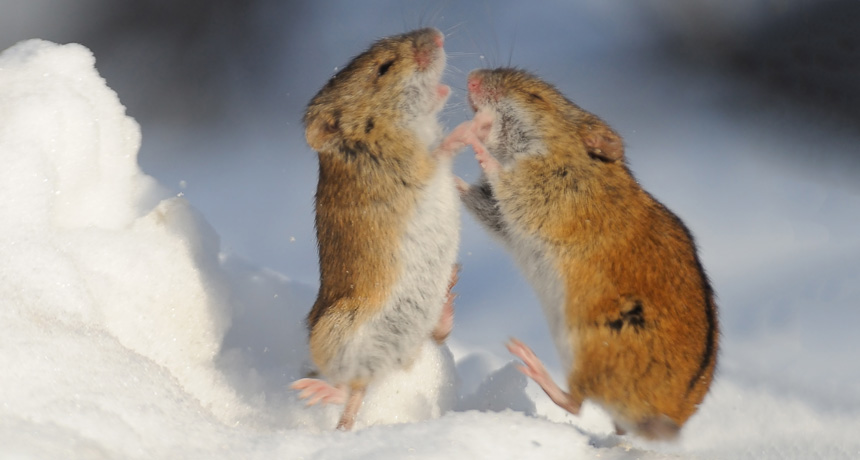
Nerve cells in a region called the dorsomedial prefrontal cortex appear to control whether male mice are dominant or submissive to other males, researchers report in the July 14 Science. The finding adds to previous evidence that this brain region is involved in social interactions in mammals.

Like men flexing muscles or flaunting sports cars to win status, male mice compete to establish a social pecking order. When every mouse knows his place, there can be less social conflict in the long run, says James Curley, a neurobiologist at the University of Texas at Austin who wasn’t part of the study.
In dominance tests, researchers pitted mice head-to-head in a plastic tube too narrow for the animals to pass each other. With no way forward, the lower-ranking mouse eventually retreats, pushed out of the tube by the more dominant mouse.

Researchers recorded the activity of individual nerve cells, or neurons, in mice’s brains while they engaged in the tube test. A group of neurons in the dorsomedial prefrontal cortex fired faster when mice were pushing forward to claim space in the tube, and fired more slowly as the mice retreated, says study coauthor Hailan Hu, a neuroscientist at Zhejiang University in Hangzhou, China.

Hu’s team then manipulated the activity of those neurons and once again measured the mice’s performance in the tube. Mice with these neurons inactivated via druglike small molecules didn’t try as hard on the tube task and were more likely to lose the competition, the researchers found. Mice with those neurons amped up with light, on the other hand, won against opponents who had previously beaten them. If those mice won enough times in one day, they’d even keep their newly elevated status for two or three days.
Other studies have also suggested a role for the prefrontal cortex in controlling social dynamics in several species, including humans, Curley says. The new study adds detail by allowing the researchers to track how neural firing influences behavior immediately and then follow the effect over time.

However, the tube experiment measures dominance dynamics in pairs of mice, Curley points out, rather than in larger groups. “Whether the same mechanism underlies social dominance under all contexts is yet to be discovered,” he says.

Other factors, such as an animal’s size, can also influence its ability to win a fight. But Hu says that persistence is key, and that this group of neurons appears to affect that quality. “In risk tests, what’s important is how much effort you want to put into the competition,” she says. “Some mice quit easily.”

Mouse studies like this one don’t translate directly to humans. But they allow scientists to study the neurobiology of dominance behaviors in levels of detail that aren’t possible in human subjects.

The study tested only male mice. In the future, Hu wants to find out whether a similar brain mechanism holds for female mice, too.
This history book offers excellent images but skimps on modern science

Books about the history of science, like many other histories, must contend with the realization that others have come before. Their tales have already been told. So such a book is worth reading, or buying, only if it offers something more than the same old stories.

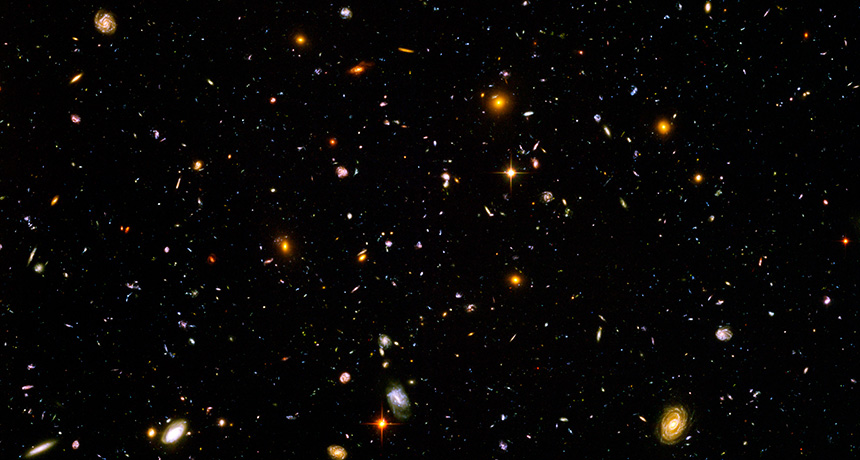
In this case, The Oxford Illustrated History of Science offers most obviously an excellent set of illustrations and photographs from science’s past, from various ancient Egyptian papyruses to the Hubble Space Telescope’s ultradeep view of distant galaxies. Some of the images will be familiar to science fans; many others are obscure but apt; nearly all help illustrate various aspects of science’s history.
And yet the pictures, while many may be worth more than 10,000 words, are still just complements to the text. Oxford attempts a novel organization for recounting the story of science: a sometimes hard-to-follow mix of chronological and topical. The first section, “Seeking Origins,” has six chapters that cover ancient Mediterranean science, science in ancient China, medieval science (one chapter for the Islamic world and Europe, one for China), plus the scientific revolution and science in the Enlightenment. The second section, “Doing Science,” shifts to experimenting, fieldwork, biology, cosmology, theory and science communication.
Each chapter has a different author, which has the plus of bringing distinct expertise to each subject matter but the minus of vast divergence in readability and caliber of content. Some chapters (see “Exploring Nature,” on field science) are wordy, repetitive and lack scientific substance. Others (“Mapping the Universe”) are compelling, engaging and richly informative. A particularly disappointing chapter on biology (“The Meaning of Life”) focuses on 19th century evolution, with only a few paragraphs for the life science of the 20th and 21st centuries. That chapter closes with an odd, antiscientific tone lamenting the “huge numbers of people … addicted to antidepressants” and complaining that modern biology (and neuroscience) “threatens to undermine traditional values of moral responsibility.”

Some of the book’s strongest chapters are the earliest, especially those that cover aspects of science often missing in other histories, such as science in China. Who knew that the ancient Chinese had their own set of ancient elements — not the Greeks’ air, earth, water and fire, but rather wood, fire, water, soil and metal?

With the book’s second-half emphasis on how science was done rather than what science found out, the history that emerges is sometimes disjointed and out of order. Discussions of the modern view of the universe, which hinges on Einstein’s general theory of relativity, appear before the chapter on theory, where relativity is mentioned. In fact, both relativity and quantum theory are treated superficially in that chapter, as examples of the work of theorists rather than the components of a second scientific revolution.
No doubt lack of space prevented deeper treatment of science from the last century. Nevertheless the book’s merits outweigh its weaknesses. For an accessible account of the story of pre-20th century science, it’s informative and enjoyable. For more recent science, you can at least look at the pictures.

Sacrificed dog remains feed tales of Bronze Age ‘wolf-men’ warriors

Remains of at least two Late Bronze Age initiation ceremonies, in which teenage boys became warriors by eating dogs and wolves, have turned up in southwestern Russia, two archaeologists say. The controversial finds, which date to between roughly 3,900 and 3,700 years ago, may provide the first archaeological evidence of adolescent male war bands described in ancient texts.

Select boys of the Srubnaya, or Timber Grave, culture joined youth war bands in winter rites, where they symbolically became dogs and wolves by consuming canine flesh, contend David Anthony and Dorcas Brown, both of Hartwick College in Oneonta, N.Y. This type of initiation ceremony coincides with myths recorded in texts from as early as roughly 2,000 years ago by speakers of Indo-European languages across Eurasia, the researchers report in the December Journal of Anthropological Archaeology.
Those myths link dogs and wolves to youthful male war bands, warfare and death. In the ancient accounts, young warriors assumed names containing words for dogs or wolves, wore dog or wolf skins and, in some cases, ate dogs during initiation ceremonies.

Mythic themes involving dogs from 2,000 years ago may differ from the rites practiced 4,000 years ago, Anthony acknowledges. “But we should look at myths across Eurasia to understand this archaeological site,” he says.
But some researchers are unconvinced by the pair’s explanation for why at least 64 dogs and wolves were sacrificed at the Krasnosamarskoe settlement.
“Archaeologists can weave mythology and prehistory together, but only with extreme caution,” says archaeologist Marc Vander Linden of University College London.
At most, Indo-European mythology suggests that Late Bronze Age folks regarded dogs as having magical properties and perhaps ate them in rituals of some kind, Vander Linden says. But no other archaeological sites have yielded evidence for teenage male war bands or canine-consuming initiation rites, raising doubts about Anthony and Brown’s proposed scenario, he argues.

Some ancient Indo-European myths attribute healing powers to dogs, says archaeologist Paul Garwood of the University of Birmingham in England. In those myths, dogs absorb illness from people, making the canines unfit for consumption. Perhaps ritual specialists at Krasnosamarskoe sacrificed dogs and wolves as part of healing ceremonies without eating the animals, Garwood proposes.

Dog and wolf deposits at the Russian site align with myths connecting these animals to war bands and initiation rites, not healing, Anthony responds.

Michael Witzel, an authority on ancient texts of India and comparative mythology at Harvard University, agrees. Anthony and Brown have identified the first archaeological evidence in support of ancient Indo-European myths about young, warlike “wolf-men” who lived outside of society’s laws, he says.

Excavations at Krasnosamarskoe in 1999 and 2001 yielded 2,770 dog bones, 18 wolf bones and six more bones that came from either dogs or wolves. Those finds represent 36 percent of all animal bones unearthed at the site. Dogs account for no more than 3 percent of animal bones previously unearthed at each of six other Srubnaya settlements, so canines were not typically eaten and may have been viewed as a taboo food under most circumstances, the investigators say.

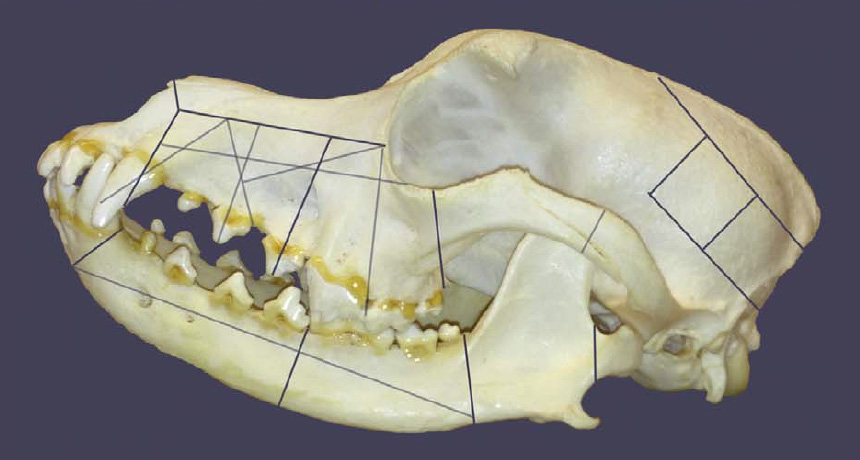
Bones from dogs’ entire bodies displayed butchery marks and burned areas produced by roasting. Dogs’ heads were chopped into 3- to 7-centimeter-wide pieces using a standardized sequence of cuts. It was a brutal, ritual behavior that demanded practice and skill, Anthony asserts. Cattle and sheep or goat remains at Krasnosamarskoe also show signs of butchery and cooking but do not include any sliced-and-diced skulls.

Separate arrays of dog bones indicate that at least two initiation ceremonies, and possibly several more, occurred over Krasnosamarskoe’s 200-year history. Microscopic analyses of annual tissue layers in tooth roots of excavated animals indicated that dogs almost always had been killed in the cold half of the year, from late fall through winter. Cattle were slaughtered in all seasons, so starvation can’t explain why dogs were sometimes killed and eaten, the researchers say.

DNA extracted from teeth of 21 dogs tagged 15 as definitely male and another four as possibly male, leaving two confirmed females. A focus on sacrificing male dogs at Krasnosamarskoe is consistent with a rite of passage for young men, Anthony says.

Excavations of a Srubnaya cemetery at the Russian site produced bones of two men, two women, an adult of undetermined sex and 22 children, most between ages 1 and 7. The two men, who both displayed injuries from activities that had put intense stress on their knees, ankles and lower backs, may have been ritual specialists, the researchers speculate. These men would have directed initiation ceremonies into war bands, Anthony says.

Seismologists get to the bottom of how deep Earth’s continents go

Earthquake vibrations are revealing just how deep the continents beneath our feet go.

Researchers analyzed seismic waves from earthquakes that have rocked various regions throughout the world, including the Americas, Antarctica and Africa. In almost every place, patterns in these waves indicated a layer of partially melted material between 130 and 190 kilometers underground.

That boundary marks the bottom of continental plates, argue Saikiran Tharimena, a seismologist at the University of Southampton in England, and colleagues. Their finding, reported in the Aug. 11 Science, may help resolve a longtime debate over the thickness of Earth’s landmasses.
Estimating continental depth “has been an issue that’s plagued scientists for quite a while,” says Tim Stern, a geophysicist at Victoria University of Wellington in New Zealand, who wasn’t involved in the work. Rock fragments belched up by volcanic eruptions suggest that the rigid rock of the continents extends about 175 kilometers underground, where it sits atop slightly runnier material in Earth’s mantle. But analyses of earthquake vibrations along Earth’s surface have suggested that continents could run 200 or 300 kilometers deep, very gradually transitioning from cold, hard rock to hotter, gooier material.

That disagreement may exist, Tharimena says, because to study continental thickness, seismologists had previously analyzed fairly shallow earthquake vibrations that couldn’t show Earth’s structure in fine detail at depths greater than about 150 kilometers.
Tharimena’s team looked at waves that bounced off boundaries between different layers in Earth’s upper mantle and other waves that ricocheted off the underside of the planet’s surface before ultimately reaching the same seismometer. By measuring how long it took for each kind of wave to reach the seismometer, the researchers could map the depths and consistencies of different layers of materials in the continental plates.
The data revealed a sharp transition from rigid rock to slightly mushier material at a depth that was fairly similar for all the continents. For instance, the melt starts about 182 kilometers under South Africa and about 163 kilometers under Antarctica. This is about as deep as diamonds — thought only to reside within continents — are known to exist, leading researchers to conclude this partially melted layer marked the bottom of the continents.

Getting this global estimate for continental thickness is “a big deal,” says Brian Savage, a geophysicist at the University of Rhode Island in Kingston who wrote a commentary on this study in the same issue of Science. The finding could help scientists make better simulations of plate tectonics, which could provide insights into what Earth looked like in the past and what it might look like in the future.

This ancient sea worm sported a crowd of ‘claws’ around its mouth

Predatory sea worms just aren’t as spiny as they used to be.

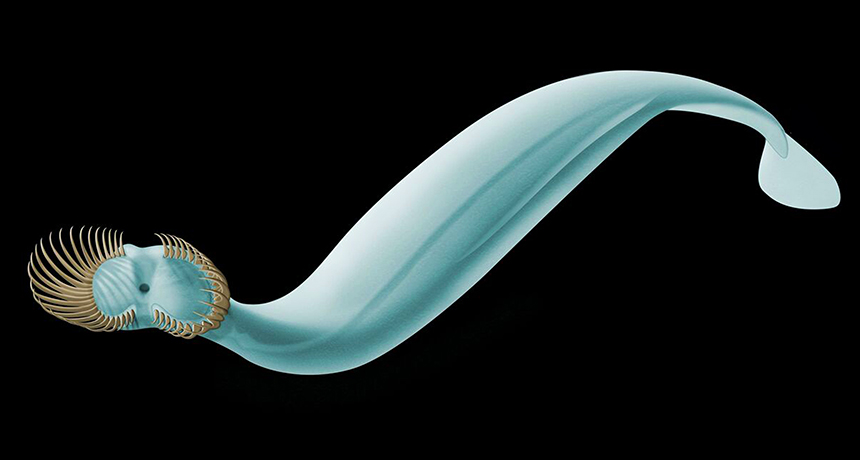
These arrow worms, which make up the phylum Chaetognatha, snatch prey with Wolverine-like claws protruding from around their mouths. Researchers now report that a newly identified species of ancient arrow worm was especially heavily armed. Dubbed Capinatator praetermissus, the predator had about 50 curved head spines, more than twice as many as most of its modern relatives. Arranged in two crescents, the spines could snap shut like a Venus flytrap to catch small invertebrates.
More than 100 species of chaetognaths are alive today, but evidence of their ancient relatives is spotty. C. praetermissus lived a little more than 500 million years ago during the Cambrian Period and was identified from 49 specimens found in the fossil-rich Burgess Shale in British Columbia, the scientists report in the Aug. 21 Current Biology. Often, only arrow worms’ clawlike spines appear in the fossil record, without soft tissue. But many of the new finds had such tissue preserved, which provided clues to body size and shape.
C. praetermissus was different enough from other chaetognaths to be labeled not only a new species, but also a new genus. The animal was at the larger end of the scale for arrow worms: about 10 centimeters from spines to tail. And while today’s arrow worms have teeth to mash up their meal after capturing it, this ancient species appears to have been toothless.
But arrow worm teeth, which are found closer to the mouth, are quite similar to spines, says study coauthor Derek Briggs, a paleontologist at Yale University. Shorter spines seen on some ancient specimens could have functioned somewhat like teeth and might have been an early evolutionary step toward tooth development, Briggs proposes.

Moons of Uranus face future collision

If you could put Uranus’ moon Cressida in a gigantic tub of water, it would float.

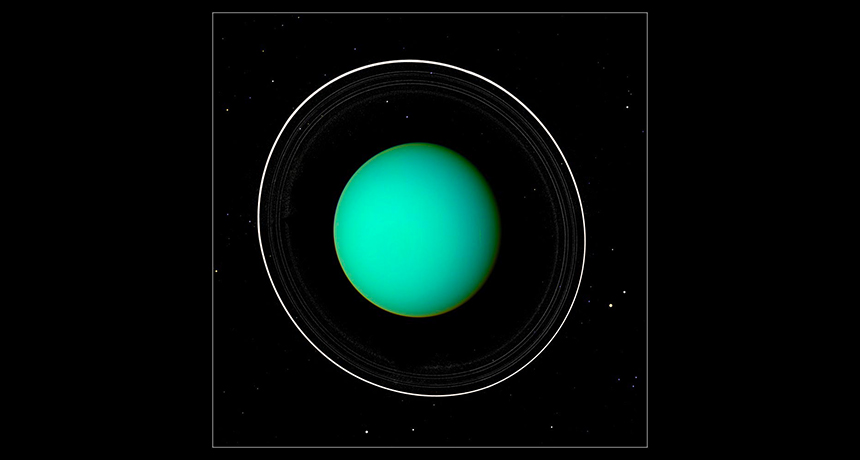
Cressida is one of at least 27 moons that circle Uranus. Robert Chancia of the University of Idaho in Moscow and colleagues calculated Cressida’s density and mass using visible variations in an inner ring of Uranus as the planet passed in front of a distant star. The moon’s density is 0.86 grams per cubic centimeter and its mass is 2.5 x 10¹⁷ kilograms. These results, reported online August 28 at arXiv.org, are the first to reveal any details about the moon. Knowing its density and mass helps researchers determine if and when Cressida might collide with another of Uranus’ moons.

Voyager 2 discovered Cressida and several other moons when the spacecraft flew by Uranus in 1986. Those moons, plus two others found later, are the most tightly packed in the solar system and orbit within 20,000 kilometers of Uranus. Such close quarters puts the moons on collision courses. Based on the newly calculated mass and density of Cressida, simulations suggest that it will slam into the moon Desdemona in under a million years. Cressida’s density indicates it is made of mostly water ice. If the other moons have similar compositions, they may have lower than expected masses, which means this and other collisions may happen in the more distant future. Determining what the moons are made of may also reveal their post-collision fate: Will they merge, bounce off of each other or shatter?

How dad’s stress changes his sperm

Sperm from stressed-out dads can carry that stress from one generation to another. “But one question that really hasn’t been addressed is, ‘How do dad’s experiences actually change his germ cell?’” Jennifer Chan, a neuroendocrinologist at the University of Pennsylvania, said November 13 in Washington, D.C., at the annual meeting of the Society for Neuroscience.

Now, from a study in mice, Chan and her colleagues have some answers, and even hints at ways to stop this stress inheritance.
The researchers focused on the part of the male reproductive tract called the caput epididymis, a place where sperm cells mature. Getting rid of a stress-hormone sensor there called the glucocorticoid receptor stopped the transmission of stress, the researchers found. When faced with an alarming predator odor, offspring of chronically stressed mice dads overproduce the stress hormone corticosterone. But mice dads that lacked this receptor in the epididymis had offspring with normal hormonal responses.

Earlier work has shown that epididymis cells release small packets filled with RNA that can fuse to sperm and change their genetic payload. Experiments on cells in dishes revealed that chronic exposure to corticosterone changed the RNA in these vesicles. The results offer an explanation of how stress can change sperm: By activating the glucocorticoid receptor, stress tweaks the RNA in epididymis vesicles. Then, those vesicles deliver their altered contents to sperm, passing stress to the next generation.

Similar vesicles are present in human seminal fluid, even after ejaculation. Chan and colleagues are testing whether humans carry similar signs of stress in these RNA-loaded vesicles by studying college students’ semen samples. Exam schedules will be used as a stress indicator, she said.

The most distant quasar ever spotted hails from the universe’s infancy

The most distant quasar yet spotted sends its light from the universe’s toddler years. The quasar, called J1342+0928, existed when the universe was only 690 million years old, right when the first stars and galaxies were forming.

Quasars are bright disks of gas and dust swirling around supermassive black holes. The black hole that powers J1342+0928 has a mass equivalent to 800 million suns, and it’s gobbling gas and dust so fast that its disk glows as bright as 40 trillion suns, Eduardo Bañados of the Carnegie Institution for Science in Pasadena, Calif., and his colleagues report December 6 in Nature.
“The newly discovered quasar gives us a unique photo of the universe when it was 5 percent [of] its present age,” Bañados says. “If the universe was a 50-year-old person, we would be seeing a photo of that person when she/he was 2 1/2 years old.”

This quasar is only slightly smaller than the previous distance record-holder, which weighs as much as 2 billion suns and whose light is 12.9 billion years old, emitted when the universe was just 770 million years old (SN: 7/30/11, p. 12). Scientists still aren’t sure how supermassive black holes like these grew so big so early.

“They either have to grow faster than we thought, or they started as a bigger baby,” says study coauthor Xiaohui Fan of the Steward Observatory in Tucson.

The temperature of the gas surrounding the newfound quasar places it squarely in the epoch of reionization (SN: 4/1/17, p. 13), when the first stars stripped electrons from atoms of gas that filled interstellar space. That switched the universe’s gas from mostly cold and neutral to hot and ionized. When this particular black hole formed, the universe was about half hot and half cold, Fan says.
“We’re very close to the epoch when the first-generation galaxies are appearing,” Fan says.

New Horizons’ next target might have a moon

NEW ORLEANS — The New Horizons team may get more than it bargained for with its next target. Currently known as 2014 MU69, the object might, in fact, be two rocks orbiting each other — and those rocks may themselves host a small moon.

MU69 orbits the sun in the Kuiper Belt, a region more than 6.5 billion kilometers from Earth. That distance makes it difficult to get pictures of the object directly. But last summer, scientists positioned telescopes around the globe to catch sight of MU69’s shadow as it passed in front of a distant background star (SN Online: 7/20/17), a cosmic coincidence known as an occultation.
Analyzing that flickering starlight raised the idea that MU69 might have two lobes, like a peanut, or might even be a pair of distinct objects. Whatever its shape, MU69 is not spherical and may not be alone, team members reported in a news conference on December 12 at the fall meeting of the American Geophysical Union.

Another stellar flicker sighting raised the prospect of a moon. On July 10, NASA’s airborne Stratospheric Observatory for Infrared Astronomy observed MU69 pass in front of a different star (SN: 3/19/16, p. 4). SOFIA saw what looked like a new, shorter dip in the star’s light. Comparing that data with orbit calculations from the European Space Agency’s Gaia spacecraft suggested that the blip could be another object around MU69.

A double object with a smaller moon could explain why MU69 sometimes shifts its position from where scientists expect it to be during occultations, said New Horizons team member Marc Buie of the Southwest Research Institute in Boulder, Colo.

The true shape will soon be revealed. The New Horizons spacecraft set its sights on the small space rock after flying past Pluto in 2015, and will fly past MU69 on January 1, 2019.

AI has found an 8-planet system like ours in Kepler data

Our solar system is no longer the sole record-holder for most known planets circling a star.

An artificial intelligence algorithm sifted through data from the planet-hunting Kepler space telescope and discovered a previously overlooked planet orbiting Kepler 90 — making it the first star besides the sun known to host eight planets. This finding, announced in a NASA teleconference December 14, shows that the kinds of clever computer codes used to translate text and recognize voices can also help discover strange new worlds.
The discovery, also reported in a paper accepted to the Astronomical Journal, can also help astronomers better understand the planetary population of our galaxy. “Finding systems like this that have lots of planets is a really neat way to test theories of planet formation and evolution,” says Jeff Coughlin, an astronomer at the SETI Institute in Mountain View, Calif., and NASA’s Ames Research Center in Moffett Field, Calif.

Kepler 90 is a sunlike star about 2,500 light-years from Earth in the constellation Draco. The latest addition to Kepler 90’s planetary family is a rocky planet about 30 percent larger than Earth called Kepler 90i. It, too, is the third planet from its sun — but with an estimated surface temperature higher than 400° Celsius, it’s probably not habitable.

Story continues below graphic
The seven previously known planets in this system range from small, rocky worlds like Kepler 90i to gas giants, which are all packed closer to their star than Earth is to the sun. “It’s very possible that Kepler 90 has even more planets,” study coauthor Andrew Vanderburg, an astronomer at the University of Texas at Austin, said in the teleconference. “There’s a lot of unexplored real estate in the Kepler 90 system.”
Astronomers have identified over 2,300 new planets in Kepler data by searching for tiny dips in a star’s brightness when a planet passes in front of it. Kepler has collected too much data for anyone to go through it all by hand, so humans or computer programs typically only verify the most promising signals of the bunch. That means that worlds that produce weaker light dips — like Kepler 90i — can get passed over. Vanderburg and Christopher Shallue, a software engineer at Google in Mountain View, Calif., designed a computer code called a neural network, which mimics the way the human brain processes information, to seek out such overlooked exoplanets.
Researchers previously automated Kepler data analysis by hard-coding programs with rules about how to detect bona fide exoplanet signals, Coughlin explains. Here, Vanderburg and Shallue provided their code with more than 10,000 Kepler signals that had been labeled by human scientists as either exoplanet or non-exoplanet signals. By studying these examples, the neural network learned on its own what the light signal of an exoplanet looked like, and could then pick out the signatures of exoplanets in previously unseen signals.

The fully trained neural network examined 670 star systems known to host multiple planets to see whether previous searches had missed anything. It spotted Kepler 90i, as well as a sixth, Earth-sized planet around the star Kepler 80. This feat marks the first time a neural network program has successfully identified new exoplanets in Kepler data, Jessie Dotson, an astrophysicist at NASA’s Ames Research Center said at the teleconference.

Vanderburg and Shallue now plan to apply their neural network to Kepler’s full cache of data on more than 150,000 stars, to see what other unrecognized exoplanets it might turn up.

Coughlin is also excited about the prospect of using artificial intelligence to assess data from future exoplanet search missions, like NASA’s TESS satellite set to launch next year. “The hits are going to keep on coming,” regarding potential exoplanet signals, he says. Having self-taught computer programs help humans slog through the data could significantly speed up the rate of scientific discovery.