Sacrificed dog remains feed tales of Bronze Age ‘wolf-men’ warriors
Remains of at least two Late Bronze Age initiation ceremonies, in which teenage boys became warriors by eating dogs and wolves, have turned up in southwestern Russia, two archaeologists say. The controversial finds, which date to between roughly 3,900 and 3,700 years ago, may provide the first archaeological evidence of adolescent male war bands described in ancient texts.

Select boys of the Srubnaya, or Timber Grave, culture joined youth war bands in winter rites, where they symbolically became dogs and wolves by consuming canine flesh, contend David Anthony and Dorcas Brown, both of Hartwick College in Oneonta, N.Y. This type of initiation ceremony coincides with myths recorded in texts from as early as roughly 2,000 years ago by speakers of Indo-European languages across Eurasia, the researchers report in the December Journal of Anthropological Archaeology.
Those myths link dogs and wolves to youthful male war bands, warfare and death. In the ancient accounts, young warriors assumed names containing words for dogs or wolves, wore dog or wolf skins and, in some cases, ate dogs during initiation ceremonies.

Mythic themes involving dogs from 2,000 years ago may differ from the rites practiced 4,000 years ago, Anthony acknowledges. “But we should look at myths across Eurasia to understand this archaeological site,” he says.
But some researchers are unconvinced by the pair’s explanation for why at least 64 dogs and wolves were sacrificed at the Krasnosamarskoe settlement.
“Archaeologists can weave mythology and prehistory together, but only with extreme caution,” says archaeologist Marc Vander Linden of University College London.
At most, Indo-European mythology suggests that Late Bronze Age folks regarded dogs as having magical properties and perhaps ate them in rituals of some kind, Vander Linden says. But no other archaeological sites have yielded evidence for teenage male war bands or canine-consuming initiation rites, raising doubts about Anthony and Brown’s proposed scenario, he argues.

Some ancient Indo-European myths attribute healing powers to dogs, says archaeologist Paul Garwood of the University of Birmingham in England. In those myths, dogs absorb illness from people, making the canines unfit for consumption. Perhaps ritual specialists at Krasnosamarskoe sacrificed dogs and wolves as part of healing ceremonies without eating the animals, Garwood proposes.

Dog and wolf deposits at the Russian site align with myths connecting these animals to war bands and initiation rites, not healing, Anthony responds.

Michael Witzel, an authority on ancient texts of India and comparative mythology at Harvard University, agrees. Anthony and Brown have identified the first archaeological evidence in support of ancient Indo-European myths about young, warlike “wolf-men” who lived outside of society’s laws, he says.

Excavations at Krasnosamarskoe in 1999 and 2001 yielded 2,770 dog bones, 18 wolf bones and six more bones that came from either dogs or wolves. Those finds represent 36 percent of all animal bones unearthed at the site. Dogs account for no more than 3 percent of animal bones previously unearthed at each of six other Srubnaya settlements, so canines were not typically eaten and may have been viewed as a taboo food under most circumstances, the investigators say.

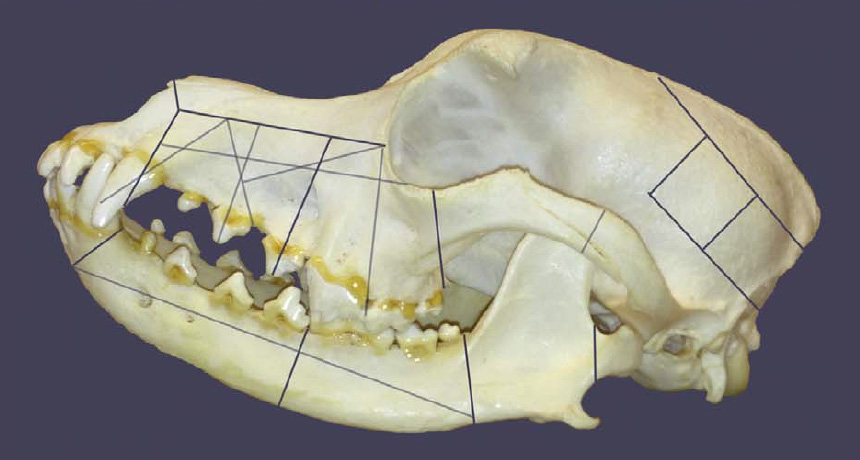
Bones from dogs’ entire bodies displayed butchery marks and burned areas produced by roasting. Dogs’ heads were chopped into 3- to 7-centimeter-wide pieces using a standardized sequence of cuts. It was a brutal, ritual behavior that demanded practice and skill, Anthony asserts. Cattle and sheep or goat remains at Krasnosamarskoe also show signs of butchery and cooking but do not include any sliced-and-diced skulls.

Separate arrays of dog bones indicate that at least two initiation ceremonies, and possibly several more, occurred over Krasnosamarskoe’s 200-year history. Microscopic analyses of annual tissue layers in tooth roots of excavated animals indicated that dogs almost always had been killed in the cold half of the year, from late fall through winter. Cattle were slaughtered in all seasons, so starvation can’t explain why dogs were sometimes killed and eaten, the researchers say.

DNA extracted from teeth of 21 dogs tagged 15 as definitely male and another four as possibly male, leaving two confirmed females. A focus on sacrificing male dogs at Krasnosamarskoe is consistent with a rite of passage for young men, Anthony says.

Excavations of a Srubnaya cemetery at the Russian site produced bones of two men, two women, an adult of undetermined sex and 22 children, most between ages 1 and 7. The two men, who both displayed injuries from activities that had put intense stress on their knees, ankles and lower backs, may have been ritual specialists, the researchers speculate. These men would have directed initiation ceremonies into war bands, Anthony says.

Seismologists get to the bottom of how deep Earth’s continents go

Earthquake vibrations are revealing just how deep the continents beneath our feet go.

Researchers analyzed seismic waves from earthquakes that have rocked various regions throughout the world, including the Americas, Antarctica and Africa. In almost every place, patterns in these waves indicated a layer of partially melted material between 130 and 190 kilometers underground.

That boundary marks the bottom of continental plates, argue Saikiran Tharimena, a seismologist at the University of Southampton in England, and colleagues. Their finding, reported in the Aug. 11 Science, may help resolve a longtime debate over the thickness of Earth’s landmasses.
Estimating continental depth “has been an issue that’s plagued scientists for quite a while,” says Tim Stern, a geophysicist at Victoria University of Wellington in New Zealand, who wasn’t involved in the work. Rock fragments belched up by volcanic eruptions suggest that the rigid rock of the continents extends about 175 kilometers underground, where it sits atop slightly runnier material in Earth’s mantle. But analyses of earthquake vibrations along Earth’s surface have suggested that continents could run 200 or 300 kilometers deep, very gradually transitioning from cold, hard rock to hotter, gooier material.

That disagreement may exist, Tharimena says, because to study continental thickness, seismologists had previously analyzed fairly shallow earthquake vibrations that couldn’t show Earth’s structure in fine detail at depths greater than about 150 kilometers.
Tharimena’s team looked at waves that bounced off boundaries between different layers in Earth’s upper mantle and other waves that ricocheted off the underside of the planet’s surface before ultimately reaching the same seismometer. By measuring how long it took for each kind of wave to reach the seismometer, the researchers could map the depths and consistencies of different layers of materials in the continental plates.
The data revealed a sharp transition from rigid rock to slightly mushier material at a depth that was fairly similar for all the continents. For instance, the melt starts about 182 kilometers under South Africa and about 163 kilometers under Antarctica. This is about as deep as diamonds — thought only to reside within continents — are known to exist, leading researchers to conclude this partially melted layer marked the bottom of the continents.

Getting this global estimate for continental thickness is “a big deal,” says Brian Savage, a geophysicist at the University of Rhode Island in Kingston who wrote a commentary on this study in the same issue of Science. The finding could help scientists make better simulations of plate tectonics, which could provide insights into what Earth looked like in the past and what it might look like in the future.

This ancient sea worm sported a crowd of ‘claws’ around its mouth

Predatory sea worms just aren’t as spiny as they used to be.

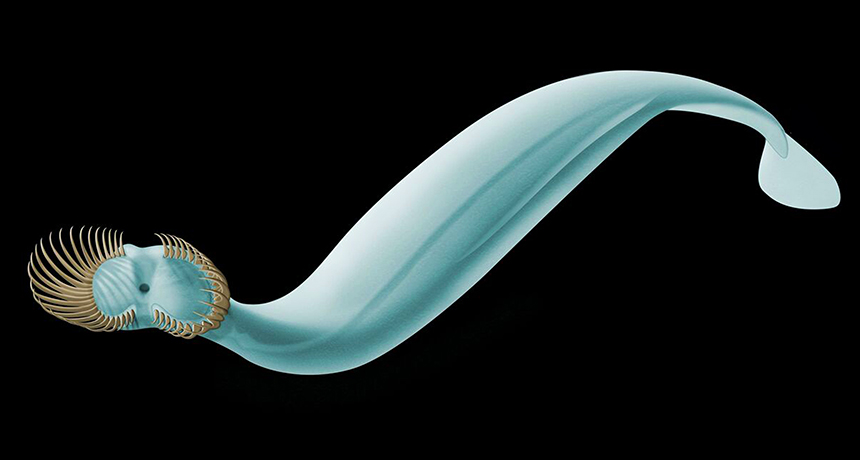
These arrow worms, which make up the phylum Chaetognatha, snatch prey with Wolverine-like claws protruding from around their mouths. Researchers now report that a newly identified species of ancient arrow worm was especially heavily armed. Dubbed Capinatator praetermissus, the predator had about 50 curved head spines, more than twice as many as most of its modern relatives. Arranged in two crescents, the spines could snap shut like a Venus flytrap to catch small invertebrates.
More than 100 species of chaetognaths are alive today, but evidence of their ancient relatives is spotty. C. praetermissus lived a little more than 500 million years ago during the Cambrian Period and was identified from 49 specimens found in the fossil-rich Burgess Shale in British Columbia, the scientists report in the Aug. 21 Current Biology. Often, only arrow worms’ clawlike spines appear in the fossil record, without soft tissue. But many of the new finds had such tissue preserved, which provided clues to body size and shape.
C. praetermissus was different enough from other chaetognaths to be labeled not only a new species, but also a new genus. The animal was at the larger end of the scale for arrow worms: about 10 centimeters from spines to tail. And while today’s arrow worms have teeth to mash up their meal after capturing it, this ancient species appears to have been toothless.
But arrow worm teeth, which are found closer to the mouth, are quite similar to spines, says study coauthor Derek Briggs, a paleontologist at Yale University. Shorter spines seen on some ancient specimens could have functioned somewhat like teeth and might have been an early evolutionary step toward tooth development, Briggs proposes.

Moons of Uranus face future collision

If you could put Uranus’ moon Cressida in a gigantic tub of water, it would float.

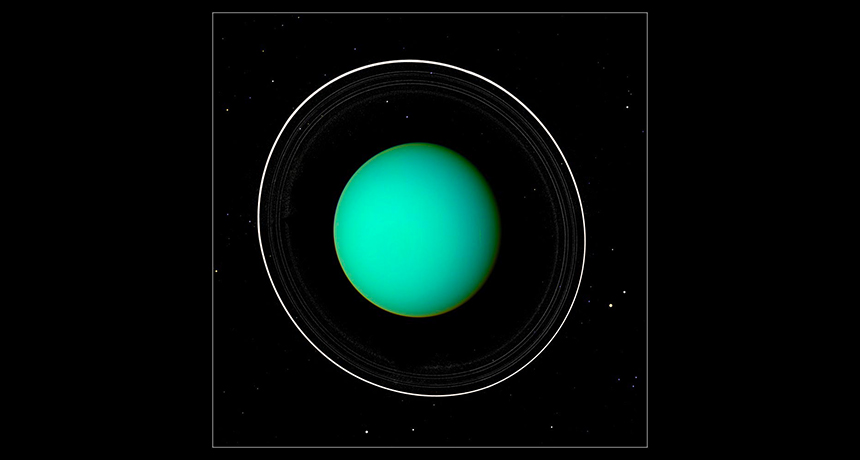
Cressida is one of at least 27 moons that circle Uranus. Robert Chancia of the University of Idaho in Moscow and colleagues calculated Cressida’s density and mass using visible variations in an inner ring of Uranus as the planet passed in front of a distant star. The moon’s density is 0.86 grams per cubic centimeter and its mass is 2.5 x 10¹⁷ kilograms. These results, reported online August 28 at arXiv.org, are the first to reveal any details about the moon. Knowing its density and mass helps researchers determine if and when Cressida might collide with another of Uranus’ moons.

Voyager 2 discovered Cressida and several other moons when the spacecraft flew by Uranus in 1986. Those moons, plus two others found later, are the most tightly packed in the solar system and orbit within 20,000 kilometers of Uranus. Such close quarters puts the moons on collision courses. Based on the newly calculated mass and density of Cressida, simulations suggest that it will slam into the moon Desdemona in under a million years. Cressida’s density indicates it is made of mostly water ice. If the other moons have similar compositions, they may have lower than expected masses, which means this and other collisions may happen in the more distant future. Determining what the moons are made of may also reveal their post-collision fate: Will they merge, bounce off of each other or shatter?

How dad’s stress changes his sperm

Sperm from stressed-out dads can carry that stress from one generation to another. “But one question that really hasn’t been addressed is, ‘How do dad’s experiences actually change his germ cell?’” Jennifer Chan, a neuroendocrinologist at the University of Pennsylvania, said November 13 in Washington, D.C., at the annual meeting of the Society for Neuroscience.

Now, from a study in mice, Chan and her colleagues have some answers, and even hints at ways to stop this stress inheritance.
The researchers focused on the part of the male reproductive tract called the caput epididymis, a place where sperm cells mature. Getting rid of a stress-hormone sensor there called the glucocorticoid receptor stopped the transmission of stress, the researchers found. When faced with an alarming predator odor, offspring of chronically stressed mice dads overproduce the stress hormone corticosterone. But mice dads that lacked this receptor in the epididymis had offspring with normal hormonal responses.

Earlier work has shown that epididymis cells release small packets filled with RNA that can fuse to sperm and change their genetic payload. Experiments on cells in dishes revealed that chronic exposure to corticosterone changed the RNA in these vesicles. The results offer an explanation of how stress can change sperm: By activating the glucocorticoid receptor, stress tweaks the RNA in epididymis vesicles. Then, those vesicles deliver their altered contents to sperm, passing stress to the next generation.

Similar vesicles are present in human seminal fluid, even after ejaculation. Chan and colleagues are testing whether humans carry similar signs of stress in these RNA-loaded vesicles by studying college students’ semen samples. Exam schedules will be used as a stress indicator, she said.

On Twitter, the lure of fake news is stronger than the truth

There’s been a lot of talk about fake news running rampant online, but now there’s data to back up the discussion.

An analysis of more than 4.5 million tweets and retweets posted from 2006 to 2017 indicates that inaccurate news stories spread faster and further on the social media platform than true stories. The research also suggests that people play a bigger role in sharing falsehoods than bots.

These findings, reported in the March 9 Science, could guide strategies for curbing misinformation on social media. Until now, most investigations into the spread of fake news have been anecdotal, says Filippo Menczer, an informatics and computer scientist at Indiana University Bloomington not involved in the work. “We didn’t have a really large-scale, systematic study evaluating the spread of misinformation,” he says.
To study rumormongering trends on Twitter, researchers examined about 126,000 tweet cascades — families of tweets composed of one original tweet and all the retweets born of that original post. All of those cascades centered on one of about 2,400 news stories that had been verified or debunked by at least one fact-checking organization.
Deb Roy, a media scientist at MIT, and colleagues investigated how far and fast each cascade spread. Discussions of false stories tended to start from fewer original tweets, but some of those retweet chains then reached tens of thousands of users, while true news stories never spread to more than about 1,600 people. True news stories also took about six times as long as false ones to reach 1,500 people. Overall, fake news was about 70 percent more likely to be retweeted than real news.
Roy and colleagues initially removed the activity of automated Twitter accounts called bots from the analysis. But when bot traffic was added back into the mix, the researchers found that these computer programs spread false and true news about equally. This finding indicates that humans, rather than bots, are primarily to blame for spreading fake news on the platform.

People may be more inclined to spread tall tales because these stories are perceived to be more novel, says study coauthor Soroush Vosoughi, a data scientist at MIT. Compared to the topics of true news stories, fake news topics tended to deviate more from the tweet themes users were exposed to in the two months before a user retweeted a news story. Tweet replies to false news stories also contained more words indicating surprise.

It’s not entirely clear what kinds of conversations these stories sparked among users, as the researchers didn’t inspect the full content of all the posts in the dataset. Some people who retweeted fake news posts may have added comments to debunk those stories. But Menczer says the analysis still provides a “very good first step” in understanding what kinds of posts grab the most attention.

The study could help guide strategies for fighting the spread of fake news, says Paul Resnick, a computational social scientist at the University of Michigan in Ann Arbor who was not involved in the work. For instance, the finding that humans are more liable to retweet falsehoods than bots may mean that social media platforms should focus on discouraging humans from spreading rumors, rather than simply booting off misbehaved bots.

To help users identify true stories online, social media sites could label news pieces or media outlets with veracity scores — similar to how grocery stores and food producers offer nutrition facts, says study coauthor Sinan Aral, an expert on information diffusion in social networks at MIT. Platforms also could restrict accounts reputed to spread lies. It’s still unclear how successful such interventions might be, Aral says. “We’re barely starting to scratch the surface on the scientific evidence about false news, its consequences and its potential solutions.”

Will Smith narrates ‘One Strange Rock,’ but astronauts are the real stars

“The strangest place in the whole universe might just be right here.” So says actor Will Smith, narrating the opening moments of a new documentary series about the wonderful unlikeliness of our own planet, Earth.

One Strange Rock, premiering March 26 on the National Geographic Channel, is itself a peculiar and unlikely creation. Executive produced by Academy Award–nominated Darren Aronofsky and by Jane Root of the production company Nutopia and narrated by Smith, the sprawling, ambitious 10-episode series is chock-full of stunningly beautiful images and CGI visuals of our dynamic planet. Each episode is united by a theme relating to Earth’s history, such as the genesis of life, the magnetic and atmospheric shields that protect the planet from solar radiation and the ways in which Earth’s denizens have shaped its surface.
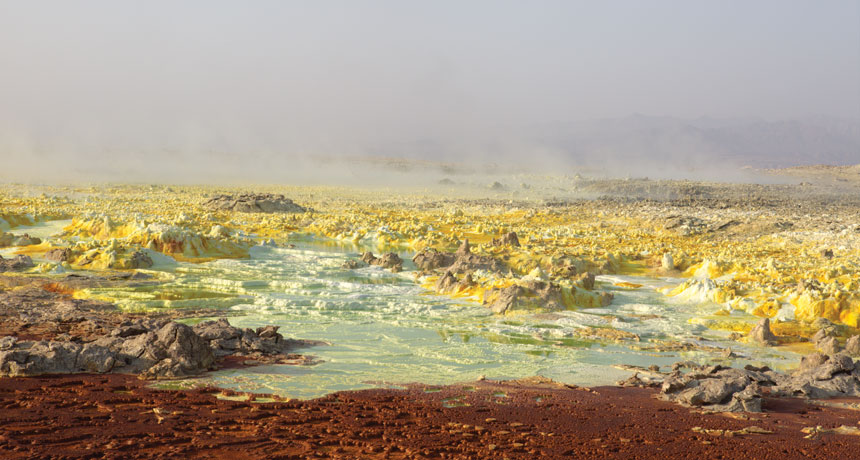
The first episode, “Gasp,” ponders Earth’s atmosphere and where its oxygen comes from. In one memorable sequence, the episode takes viewers on a whirlwind journey from Ethiopia’s dusty deserts to the Amazon rainforest to phytoplankton blooms in the ocean. Dust storms from Ethiopia, Smith tells us, fertilize the rainforest. And that rainforest, in turn, feeds phytoplankton. A mighty atmospheric river, fueled by water vapor from the Amazon and heat from the sun, flows across South America until it reaches the Andes and condenses into rain. That rain erodes rock and washes nutrients into the ocean, feeding blooms of phytoplankton called diatoms. One out of every two breaths that we take comes from the photosynthesis of those diatoms, Smith adds.
As always, Smith is an appealing everyman. But the true stars of the series may be the eight astronauts, including Chris Hadfield and Nicole Stott, who appear throughout the series. In stark contrast to the colorful images of the planet, the astronauts are filmed alone, their faces half in shadow against a black background as they tell stories that loosely connect to the themes. The visual contrast emphasizes the astronauts’ roles as outsiders who have a rare perspective on the blue marble.
“Having flown in space, I feel this connection to the planet,” Stott told Science News . “I was reintroduced to the planet.” Hadfield had a similar sentiment: “It’s just one tiny place, but it’s the tiny place that is ours,” he added.
Each astronaut anchors a different episode. In “Gasp,” Hadfield describes a frightening moment during a spacewalk outside the International Space Station when his eyes watered. Without gravity, the water couldn’t form into teardrops, so it effectively blinded him. To remove the water, he was forced to allow some precious air to escape his suit. It’s a tense moment that underscores the pricelessness of the thin blue line, visible from space, that marks Earth’s atmosphere. “It contains everything that’s important to us,” Hadfield says in the episode. “It contains life.”

Stott, meanwhile, figures prominently in an episode called “Storm.” Instead of a weather system, the title refers to the rain of space debris that Earth has endured throughout much of its history — including the powerful collision that formed the moon (SN: 4/15/17, p. 18). Stott describes her own sense of wonder as a child, watching astronauts land on our closest neighbor — and how the travels of those astronauts and the rocks they brought back revealed that Earth and the moon probably originated from the same place.

It’s glimpses like these into the astronauts’ lives and personalities — scenes of Hadfield strumming “Space Oddity” on a guitar, for example, or Stott chatting with her son in the family kitchen — that make the episodes more than a series of beautiful and educational IMAX films. Having been away from the planet for a short time, the astronauts see Earth as precious, and they convey their affection for it well. Stott said she hopes that this will be the ultimate takeaway for viewers, for whom the series may serve as a reintroduction to the planet they thought they knew so well. “I hope that people will … appreciate and acknowledge the significance of [this reintroduction],” she said, “that it will result in an awareness and obligation to take care of each other.”
Editor’s note: This story was updated on March 19, 2018, to add a mention of a second executive producer.