Every breath you take contains a molecule of history
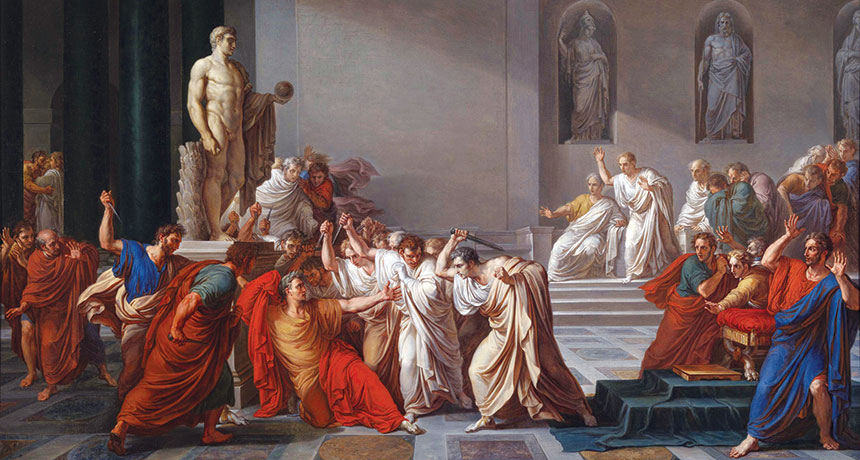
Julius Caesar could have stayed home on March 15, 44 B.C. But mocking the soothsayer who had predicted his death, the emperor rode in his litter to Rome’s Forum. There he met the iron daggers of 60 senators.

As he lay in a pool of blood, he may have gasped a final incrimination to his protégé Brutus: You too, my son? Or maybe not. But he certainly would have breathed a dying breath, a final exhalation of some 25 sextillion gas molecules. And it’s entirely possible that you just breathed in one of them.
In fact, calculating the probability of a particle of Caesar’s dying breath appearing in any given liter of air (the volume of a deep breath) has become a classic exercise for chemistry and physics students. If you make a few assumptions about the mixing of gases and the lifetimes of molecules in the atmosphere, it turns out that, on average, one molecule of “Caesar air” — or any other historic liter of air, for that matter — appears in each breath you take.

Author Sam Kean begins his book Caesar’s Last Breath with this exercise, noting that “we can’t escape the air of those around us.” It’s all recycled, and every day we breathe in a bit of our, and Earth’s, history. “The story of Earth,” he writes, “is the story of its gases.”

Kean, author of a best seller about the periodic table, The Disappearing Spoon, then tells that story. As he did in his fascinating portraits of the elements, Kean profiles individual gases such as nitrogen and oxygen primarily through the scientists and entrepreneurs who discovered or sought to harness them. These are quirky men (and they are mostly men) — every bit as obsessed, greedy and brilliant as one could hope for in a page-turner.

Along with lesser-known backstories of textbook heroes such as James Watt, Antoine-Laurent Lavoisier and Albert Einstein (who was surprisingly obsessed with building a better refrigerator), Kean clearly delights in weaving in the unexpected. In the discussion of helium, we learn about Joseph-Michel Montgolfier, the papermaker who was inspired to build the first hot-air balloon as he watched his wife’s pantaloons billowing suggestively above a fire. And in a chapter on the radioactive elements carried in nuclear fallout, there’s Pig 311, a sow that survived a nuclear test blast only to be used as propaganda for the weapons’ supposed safety.

Along the way, Kean threads in the history of Earth’s atmosphere in a surprisingly compelling narrative of geologic history. He steps aside from Lavoisier’s work on life-giving oxygen, for example, to describe the Great Oxygenation Event, which infused the atmosphere a couple billion years ago with a gas that, at the time, was toxic to most living things. The explanations of science here and throughout the book are written clearly and at a level that should be understandable with a high school education. And while they’re straightforward, the explanations have enough depth to be satisfying; by the end of the book, you realize you’ve learned quite a bit.
Even those who rarely read science will enjoy the drama — death, for instance, plays a big role in these stories. Over and over, we learn, men have taken gases’ powers too lightly, or wielded their own power too cruelly, and paid the price. Fritz Haber, for instance, could have died a hero for finding a way to make fertilizer from the nitrogen in air. Instead, he died broke and loathed for his World War I work on gas warfare.

Then there was Harry Truman — not that Truman, but the one who refused to leave his home when scientists warned of an impending volcanic eruption. Truman contended that officials were “lying like horses trot” right up until Mount St. Helens blew searing gases that erased him from the mountainside.

The links between these stories can seem at first as ephemeral as the gases, but together they tell the story of the birth of the atmosphere and humans’ history in it. In the end, like Caesar’s breath, it all comes full circle.
This history book offers excellent images but skimps on modern science

Books about the history of science, like many other histories, must contend with the realization that others have come before. Their tales have already been told. So such a book is worth reading, or buying, only if it offers something more than the same old stories.

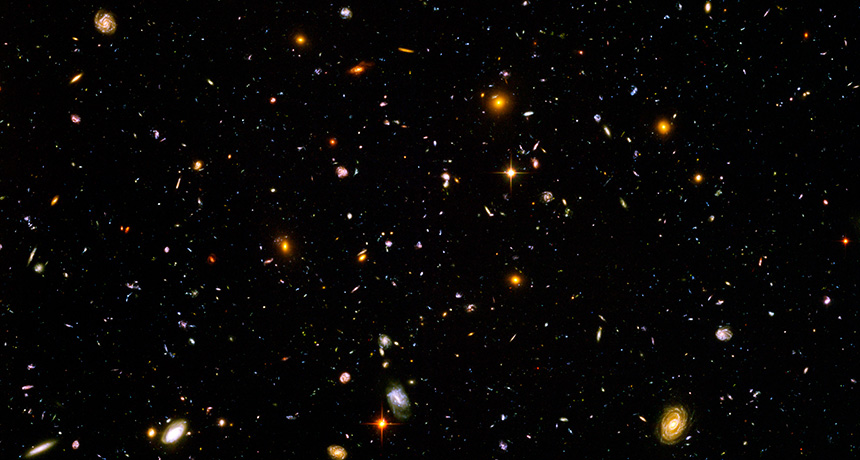
In this case, The Oxford Illustrated History of Science offers most obviously an excellent set of illustrations and photographs from science’s past, from various ancient Egyptian papyruses to the Hubble Space Telescope’s ultradeep view of distant galaxies. Some of the images will be familiar to science fans; many others are obscure but apt; nearly all help illustrate various aspects of science’s history.
And yet the pictures, while many may be worth more than 10,000 words, are still just complements to the text. Oxford attempts a novel organization for recounting the story of science: a sometimes hard-to-follow mix of chronological and topical. The first section, “Seeking Origins,” has six chapters that cover ancient Mediterranean science, science in ancient China, medieval science (one chapter for the Islamic world and Europe, one for China), plus the scientific revolution and science in the Enlightenment. The second section, “Doing Science,” shifts to experimenting, fieldwork, biology, cosmology, theory and science communication.
Each chapter has a different author, which has the plus of bringing distinct expertise to each subject matter but the minus of vast divergence in readability and caliber of content. Some chapters (see “Exploring Nature,” on field science) are wordy, repetitive and lack scientific substance. Others (“Mapping the Universe”) are compelling, engaging and richly informative. A particularly disappointing chapter on biology (“The Meaning of Life”) focuses on 19th century evolution, with only a few paragraphs for the life science of the 20th and 21st centuries. That chapter closes with an odd, antiscientific tone lamenting the “huge numbers of people … addicted to antidepressants” and complaining that modern biology (and neuroscience) “threatens to undermine traditional values of moral responsibility.”

Some of the book’s strongest chapters are the earliest, especially those that cover aspects of science often missing in other histories, such as science in China. Who knew that the ancient Chinese had their own set of ancient elements — not the Greeks’ air, earth, water and fire, but rather wood, fire, water, soil and metal?

With the book’s second-half emphasis on how science was done rather than what science found out, the history that emerges is sometimes disjointed and out of order. Discussions of the modern view of the universe, which hinges on Einstein’s general theory of relativity, appear before the chapter on theory, where relativity is mentioned. In fact, both relativity and quantum theory are treated superficially in that chapter, as examples of the work of theorists rather than the components of a second scientific revolution.
No doubt lack of space prevented deeper treatment of science from the last century. Nevertheless the book’s merits outweigh its weaknesses. For an accessible account of the story of pre-20th century science, it’s informative and enjoyable. For more recent science, you can at least look at the pictures.

Sacrificed dog remains feed tales of Bronze Age ‘wolf-men’ warriors

Remains of at least two Late Bronze Age initiation ceremonies, in which teenage boys became warriors by eating dogs and wolves, have turned up in southwestern Russia, two archaeologists say. The controversial finds, which date to between roughly 3,900 and 3,700 years ago, may provide the first archaeological evidence of adolescent male war bands described in ancient texts.

Select boys of the Srubnaya, or Timber Grave, culture joined youth war bands in winter rites, where they symbolically became dogs and wolves by consuming canine flesh, contend David Anthony and Dorcas Brown, both of Hartwick College in Oneonta, N.Y. This type of initiation ceremony coincides with myths recorded in texts from as early as roughly 2,000 years ago by speakers of Indo-European languages across Eurasia, the researchers report in the December Journal of Anthropological Archaeology.
Those myths link dogs and wolves to youthful male war bands, warfare and death. In the ancient accounts, young warriors assumed names containing words for dogs or wolves, wore dog or wolf skins and, in some cases, ate dogs during initiation ceremonies.

Mythic themes involving dogs from 2,000 years ago may differ from the rites practiced 4,000 years ago, Anthony acknowledges. “But we should look at myths across Eurasia to understand this archaeological site,” he says.
But some researchers are unconvinced by the pair’s explanation for why at least 64 dogs and wolves were sacrificed at the Krasnosamarskoe settlement.
“Archaeologists can weave mythology and prehistory together, but only with extreme caution,” says archaeologist Marc Vander Linden of University College London.
At most, Indo-European mythology suggests that Late Bronze Age folks regarded dogs as having magical properties and perhaps ate them in rituals of some kind, Vander Linden says. But no other archaeological sites have yielded evidence for teenage male war bands or canine-consuming initiation rites, raising doubts about Anthony and Brown’s proposed scenario, he argues.

Some ancient Indo-European myths attribute healing powers to dogs, says archaeologist Paul Garwood of the University of Birmingham in England. In those myths, dogs absorb illness from people, making the canines unfit for consumption. Perhaps ritual specialists at Krasnosamarskoe sacrificed dogs and wolves as part of healing ceremonies without eating the animals, Garwood proposes.

Dog and wolf deposits at the Russian site align with myths connecting these animals to war bands and initiation rites, not healing, Anthony responds.

Michael Witzel, an authority on ancient texts of India and comparative mythology at Harvard University, agrees. Anthony and Brown have identified the first archaeological evidence in support of ancient Indo-European myths about young, warlike “wolf-men” who lived outside of society’s laws, he says.

Excavations at Krasnosamarskoe in 1999 and 2001 yielded 2,770 dog bones, 18 wolf bones and six more bones that came from either dogs or wolves. Those finds represent 36 percent of all animal bones unearthed at the site. Dogs account for no more than 3 percent of animal bones previously unearthed at each of six other Srubnaya settlements, so canines were not typically eaten and may have been viewed as a taboo food under most circumstances, the investigators say.

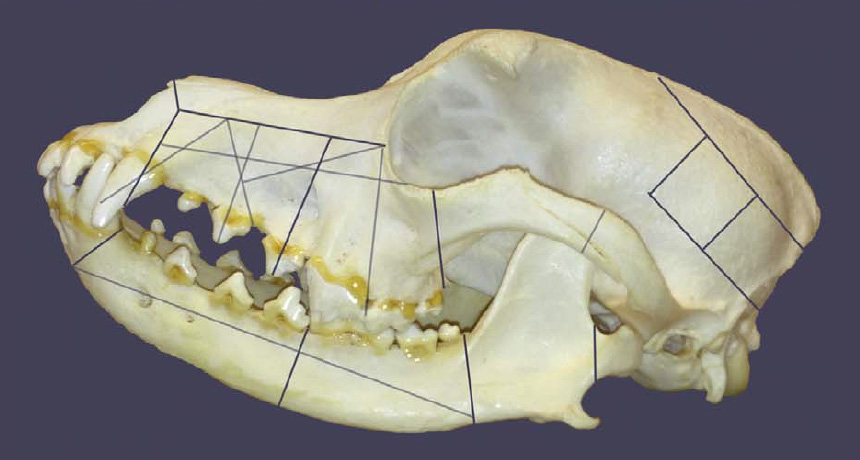
Bones from dogs’ entire bodies displayed butchery marks and burned areas produced by roasting. Dogs’ heads were chopped into 3- to 7-centimeter-wide pieces using a standardized sequence of cuts. It was a brutal, ritual behavior that demanded practice and skill, Anthony asserts. Cattle and sheep or goat remains at Krasnosamarskoe also show signs of butchery and cooking but do not include any sliced-and-diced skulls.

Separate arrays of dog bones indicate that at least two initiation ceremonies, and possibly several more, occurred over Krasnosamarskoe’s 200-year history. Microscopic analyses of annual tissue layers in tooth roots of excavated animals indicated that dogs almost always had been killed in the cold half of the year, from late fall through winter. Cattle were slaughtered in all seasons, so starvation can’t explain why dogs were sometimes killed and eaten, the researchers say.

DNA extracted from teeth of 21 dogs tagged 15 as definitely male and another four as possibly male, leaving two confirmed females. A focus on sacrificing male dogs at Krasnosamarskoe is consistent with a rite of passage for young men, Anthony says.

Excavations of a Srubnaya cemetery at the Russian site produced bones of two men, two women, an adult of undetermined sex and 22 children, most between ages 1 and 7. The two men, who both displayed injuries from activities that had put intense stress on their knees, ankles and lower backs, may have been ritual specialists, the researchers speculate. These men would have directed initiation ceremonies into war bands, Anthony says.

Seismologists get to the bottom of how deep Earth’s continents go

Earthquake vibrations are revealing just how deep the continents beneath our feet go.

Researchers analyzed seismic waves from earthquakes that have rocked various regions throughout the world, including the Americas, Antarctica and Africa. In almost every place, patterns in these waves indicated a layer of partially melted material between 130 and 190 kilometers underground.

That boundary marks the bottom of continental plates, argue Saikiran Tharimena, a seismologist at the University of Southampton in England, and colleagues. Their finding, reported in the Aug. 11 Science, may help resolve a longtime debate over the thickness of Earth’s landmasses.
Estimating continental depth “has been an issue that’s plagued scientists for quite a while,” says Tim Stern, a geophysicist at Victoria University of Wellington in New Zealand, who wasn’t involved in the work. Rock fragments belched up by volcanic eruptions suggest that the rigid rock of the continents extends about 175 kilometers underground, where it sits atop slightly runnier material in Earth’s mantle. But analyses of earthquake vibrations along Earth’s surface have suggested that continents could run 200 or 300 kilometers deep, very gradually transitioning from cold, hard rock to hotter, gooier material.

That disagreement may exist, Tharimena says, because to study continental thickness, seismologists had previously analyzed fairly shallow earthquake vibrations that couldn’t show Earth’s structure in fine detail at depths greater than about 150 kilometers.
Tharimena’s team looked at waves that bounced off boundaries between different layers in Earth’s upper mantle and other waves that ricocheted off the underside of the planet’s surface before ultimately reaching the same seismometer. By measuring how long it took for each kind of wave to reach the seismometer, the researchers could map the depths and consistencies of different layers of materials in the continental plates.
The data revealed a sharp transition from rigid rock to slightly mushier material at a depth that was fairly similar for all the continents. For instance, the melt starts about 182 kilometers under South Africa and about 163 kilometers under Antarctica. This is about as deep as diamonds — thought only to reside within continents — are known to exist, leading researchers to conclude this partially melted layer marked the bottom of the continents.

Getting this global estimate for continental thickness is “a big deal,” says Brian Savage, a geophysicist at the University of Rhode Island in Kingston who wrote a commentary on this study in the same issue of Science. The finding could help scientists make better simulations of plate tectonics, which could provide insights into what Earth looked like in the past and what it might look like in the future.