An antimatter atom abides by the same rules as its matter look-alike. Scientists studying antihydrogen have found that the energy needed to bump the atoms into an excited, or high-energy, state is the same as for normal hydrogen atoms.
Scientists at the European particle physics lab CERN in Geneva created antihydrogen atoms by combining antiprotons and positrons, the electron’s antiparticle. Hitting the resulting atoms with a laser tuned to a particular frequency of light boosted the antihydrogen atoms to a higher energy. The frequency of laser light needed to induce this transition was the same as that needed for normal hydrogen atoms, indicating that the energy jump was the same, scientists from the ALPHA-2 experiment report December 19 in Nature.
Antihydrogen’s similarity to hydrogen conforms to a principle known as charge-parity-time, or CPT, symmetry — the idea that the laws of physics would be unchanged if the universe were reflected in a mirror, time reversed, and particles swapped with antiparticles. So far scientists have never discovered a situation where this symmetry doesn’t hold up, but antihydrogen provides a precise way to check for subtle breakdowns in the rule.
Differences between matter and antimatter are essential for the existence of the universe as we know it: The Big Bang produced equal amounts matter and antimatter, yet somehow antimatter became very rare. So scientists are still on the lookout for any unexpected behavior from antimatter.
GRAPEVINE, TEXAS — A pair of cosmic radio beacons known as pulsars keep switching off and on, suggesting that there might be vast numbers of undiscovered pulsars hiding in our galaxy.
Pulsars are rapidly spinning neutron stars, the ultradense cores left behind after massive stars explode. Neutron stars are like lighthouses, sweeping a beam of radio waves around the sky. Astronomers see them as steady pulses of radio energy.
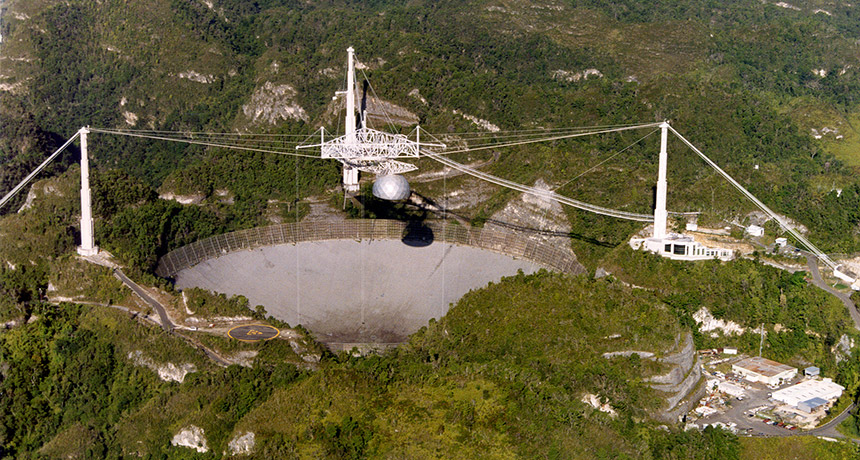
But at least two in the Milky Way seem to spend most of their time turned off, Victoria Kaspi, an astrophysicist at McGill University in Montreal, reported January 4 at a meeting of the American Astronomical Society. One, first detected at Arecibo Observatory in Puerto Rico in November 2011, only pulses about 30 percent of the time. Another, also discovered at Arecibo, laid down a steady beat just 0.8 percent of the time when observed in 2013 and 2015. Then starting in August 2015, it abruptly jumped to being on 16 percent of the time for several months. When sending out pulses, the pulsars seem to behave like any other pulsar, Kaspi said. “You wouldn’t know that they have this dual personality.” Researchers don’t yet know why some pulsars behave this way. But Kaspi said that it’s probably tied to changes in their magnetic fields, which astronomers think help control the radio beacons.
These two intermittent pulsars join three others that had been previously observed. Given that most spend much of their time off, Kaspi said, astronomers might be missing a large population of pulsars in the Milky Way.
A new squishy robot could keep hearts from skipping a beat.
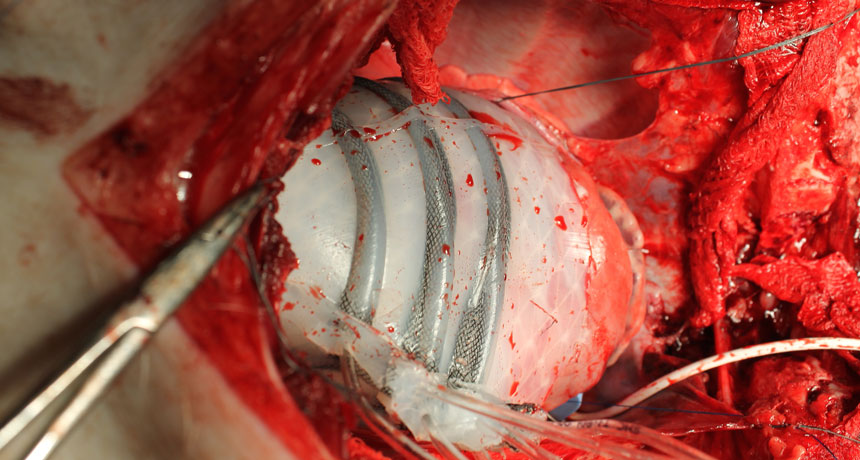
A silicone sleeve slipped over pigs’ hearts helped pump blood when the hearts failed, researchers report January 18 in Science Translational Medicine. If the sleeve works in humans, it could potentially keep weak hearts pumping, and buy time for patients waiting for a transplant.
To make the device contract, biomedical engineer Ellen Roche and colleagues lined it with two sets of narrow tubes. One set encircles the sleeve, like bracelets; the other runs from top to bottom. When air pumps through the tubes, the sleeve compresses (like a clenched fist) and twists (like wrung-out laundry). Those actions mimic how the layers of the heart contract. Researchers programmed the sleeve to sync with the heart’s motion. And like a healthy heart, the robot sleeve’s double squeeze gets blood moving.
Roche’s team, which did the work while she was at Harvard University, triggered heart failure in six pigs and then measured the volume of blood pumped by the heart with and without the sleeve’s help. Heart failure cut the volume roughly in half, to about 1 liter of blood per minute. But the sleeve restored the pumped volume to about 2½ liters per minute — just about normal, Roche, now at National University of Ireland, Galway, and colleagues report.
An analysis of nearly 400 kinds of tomatoes suggests which flavor compounds could bring heirloom deliciousness back to varieties that were bred for toughness over taste.
About 30 compounds are important in creating a full-bodied tomato flavor, says study coauthor Harry Klee of the University of Florida in Gainesville. He and colleagues have identified 13 important molecules that have dwindled away in many mass-market varieties. Some of the flavor compounds deliver such a thrill to the human sensory system that even a modest increase could make a big difference, the researchers report January 26 in Science. “I think this will definitely help,” says Alisdair Fernie, who was not part of the study but has studied tomato chemistry at the Max Planck Institute of Molecular Plant Physiology in Potsdam, Germany. “Taste is incredibly complex,” he says, so creating more appealing commercial varieties “for certain, requires a holistic approach,” he says.
To achieve that holistic view, the researchers teamed up with geneticists at China’s Agricultural Genomics Institute in Shenzhen, who determined the full genetic makeup of a whopping 398 kinds of tomatoes, wild as well as heirloom and commercial. The scientists ran 96 varieties of tomatoes through taste-testing panels, looking for genetic and chemical similarities among those varieties ranked tastiest.
Much of what makes some tomatoes taste better is actually smell, Klee points out. Tongues can detect relatively few qualities, such as sweetness, acidity and softness. Chemical detectors in the nasal passages are far more varied and sensitive. So what really puts the “Mmmm” into a tomato is the whoosh of air forced up into the nasal passages as someone swallows. Airborne compounds, known as volatiles, are abundant in tomatoes, and Klee looks to them for flavor magic.
Of these volatile compounds, some appear in even the tastiest tomatoes at minuscule levels — only parts per trillion. But human senses respond so strongly to the odors that a little bit goes a long way. Tomatoes should taste noticeably better if researchers can breed just four or five heirloom versions of volatile-producing genes back into commercial varieties, Klee says.
Increasing the sweetness of today’s tomatoes, on the other hand, may be tougher. About 80 percent of the sugar in commercial tomatoes comes from the leaves and is transferred to the big red globes as they mature (SN: 7/28/12, p. 18). Because breeders have done such a great job of maximizing the number of fruits on a plant, the plants would need lots of leaves to sweeten them all. So the price of sweeter tomatoes would be making them smaller, and fewer. “Now we come to the real crux of the problem,” Klee says. “I have to fix the flavor, but I can’t compromise all of the stuff that breeders have done to the modern tomatoes to make them healthier, more productive, more disease resistant and more shippable,” he says.
And let’s not forget about what happens to tomatoes after they’re picked, says Ann Powell, who studied tomato ripening and disease resistance at the University of California, Davis and is now at the National Science Foundation. Cooling weakens flavor, as cooks who shriek at the horror of storing tomatoes in refrigerators have long known. Therefore, Powell says, another study of Klee’s from 2016 — on how chilling can turn on and off genes — makes an important companion to the new work. A combination of breeding better plants and coddling them strategically may be the way forward for tastier tomatoes.
In a remote corner of eastern Russia, where long winters bring temperatures that rarely flicker above freezing, the genetic legacy of ancient hunter-gatherers endures.
DNA from the 7,700-year-old remains of two women is surprisingly similar to that of people living in that area today, researchers report February 1 in Science Advances. That finding suggests that at least some people in East Asia haven’t changed much over the last 8,000 years or so — a time when other parts of the world saw waves of migrants settle in. “The continuity is remarkable,” says paleogeneticist Carles Lalueza-Fox of the Institute of Evolutionary Biology in Barcelona, who was not involved with the work. “It’s a big contrast to what has been found in Europe.”
In Western Europe especially, scientists studying ancient DNA have put together a picture of flux, says study coauthor Andrea Manica. “Every few thousand years, there are major turnovers of people.” Around 8,000 years ago, he says, migrating farmers replaced hunter-gatherers in the area. And a few thousand years after that, Bronze Age migrants from Central Asia swept in.
In DNA collected from the bones and teeth of these ancient peoples, scientists can spot genetic signatures of different populations. When a population of farmers balloons, Lalueza-Fox says, the signatures of hunter-gatherers are mostly erased.
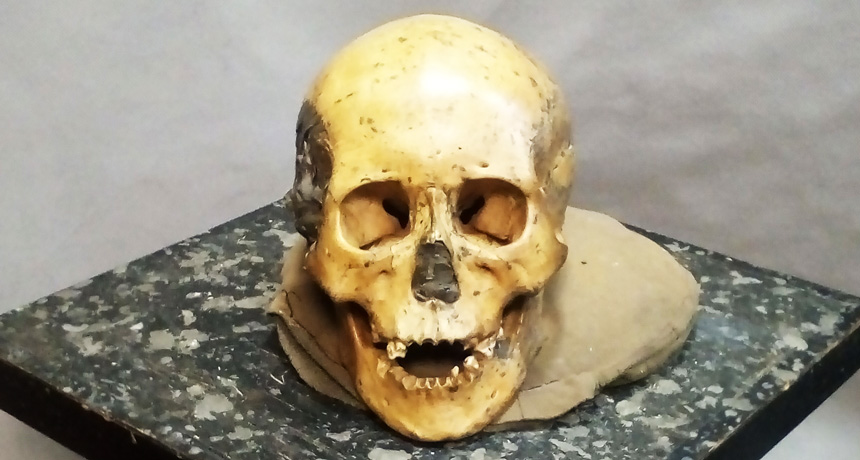
But whether that’s true across the globe is unclear, says Manica, of the University of Cambridge. “We wanted to see what happened in other places…. Asia is huge compared to Europe, and it’s been neglected.” Manica’s team collected DNA from the skeletons of five ancient people found in a cave called Devil’s Gate. The cave rests in a far east finger of Russia, tucked along the border of China and North Korea, and holds human remains, scraps of textiles and bits of broken pottery.
Researchers gathered enough DNA from two of the people to piece together about 6 percent of the genome, the complete set of genetic instructions inside a cell’s nucleus. That’s not much, Manica says, but it’s enough to compare the Devil’s Gate denizens with other people. The researchers analyzed the genomes of people strewn across the far reaches of the continent — from the Dolgan in Siberia to the Thai thousands of kilometers south.
Genetically, the 7,700-year-old women closely resembled the Ulchi, a small group of hunter-fishers who still live off the land today. Manica can’t say whether the Ulchi are direct descendants of the two Devil’s Gate women, or just closely related. But the find suggests a pocket of stability in East Asia — a place where hunter-gatherers weren’t swept out by, or folded into, booming groups of farmers.
Perhaps farming didn’t take off there because the cold climate wasn’t good for growing crops, Manica says. Or maybe the ideas and technologies from farmers and other migrants made it to the Ulchi without an accompanying influx of people. (The Ulchi aren’t like primitive hunter-gatherers of the past. They farm a bit, and have adopted new ways to fish, hunt and store food, he points out.)
“This shows that ideas can travel without people moving with them,” Manica says.
That makes sense, Lalueza-Fox says. But scientists now need more data — additional samples from East Asia, and Southeast Asia, too, he says. “I have a feeling the whole story will be much more complicated.”
To some forest creatures, a tree is a home. To scientists, it’s a beacon. A new way of mapping forests from the air by measuring chemical signatures of the tree canopy is revealing previously unrecognized biodiversity.
The swath of tropical forest covering the Peruvian Andes Mountains and the Amazon basin is one of the most biodiverse places on Earth. But it’s such a wild and remote region that variation within the forest is hard to spot. “If you look in Google Earth, it just looks like a big green blanket,” says study coauthor Greg Asner, an ecologist at the Carnegie Institution for Science in Stanford, Calif.
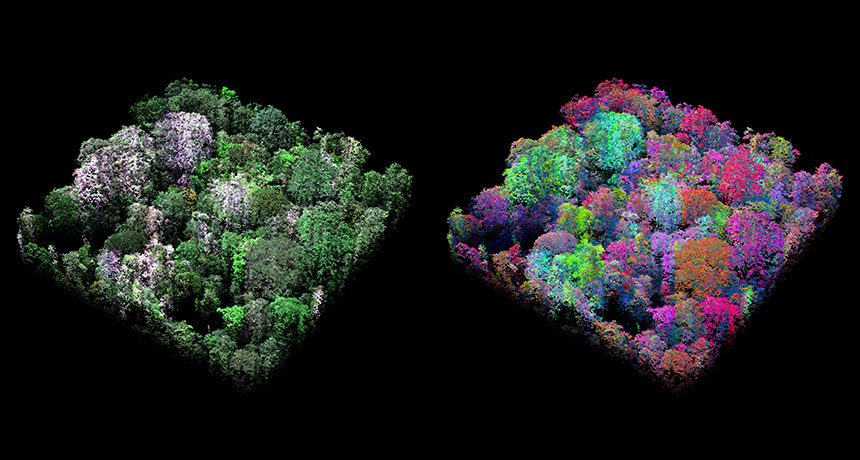
Up close, it’s a different story. Each tree species has a distinctive set of chemical traits, such as levels of nutrients like nitrogen and phosphorus in the leaves. Collectively, those characteristics can reveal a lot about the makeup of the forest. To peek beneath the green blanket, Asner and colleagues divided 76 million hectares of forest into 100-kilometer squares. The researchers measured levels of water, nitrogen, phosphorus and calcium in the trees’ leaves via aircraft by measuring the wavelengths of light reflected by the forest canopy, taking samples from small areas of each square. They also mapped leaf levels of lignins and polyphenols, two chemicals used for defense. Using that data, the scientists identified 36 unique types of forest — a much more nuanced view than the broad categories currently used for classification, the researchers report January 27 in Science. They parceled those highly specific forest types into six groups that roughly aligned with the country’s topography and geography. Parsing out these differences in forests at such a fine scale is important for guiding conservation efforts, Asner says. A particular spot might appear at a distance to be the same as its surroundings but may actually contain species found nowhere else.
The team is now carrying out similar studies in northern Borneo and Ecuador. Eventually the researchers hope to boost their sensors into orbit to map biodiversity around the globe.
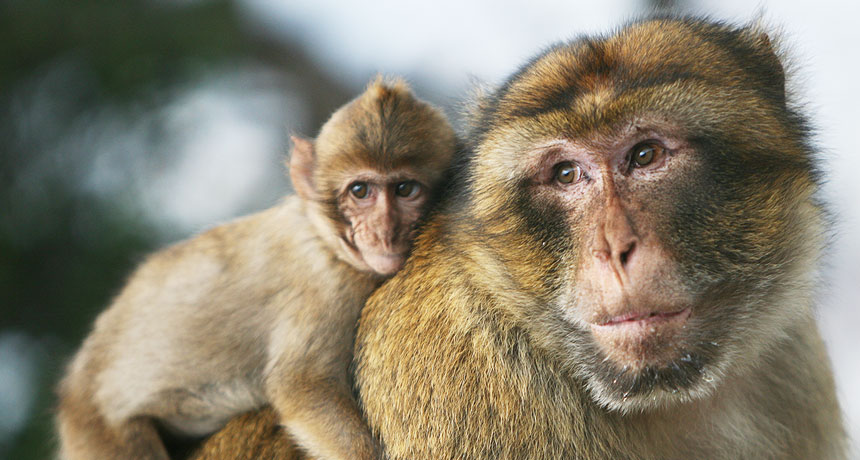
The social lives of macaques and baboons play out in what primatologist Julia Fischer calls “a magnificent opera.” When young Barbary macaques reach about 6 months, they fight nightly with their mothers. Young ones want the “maternal embrace” as they snooze; mothers want precious alone time. Getting pushed away and bitten by dear old mom doesn’t deter young macaques. But they’re on their own when a new brother or sister comes along. In Monkeytalk, Fischer describes how the monkey species she studies have evolved their own forms of intelligence and communication. Connections exist between monkey and human minds, but Fischer regards differences among primate species as particularly compelling. She connects lab studies of monkeys and apes to her observations of wild monkeys while mixing in offbeat personal anecdotes of life in the field.
Fischer catapulted into a career chasing down monkeys in 1993. While still in college, she monitored captive Barbary macaques. That led to fieldwork among wild macaques in Morocco. In macaque communities, females hold central roles because young males move to other groups to mate. Members of closely related, cooperative female clans gain an edge in competing for status with male newcomers. Still, adult males typically outrank females. Fischer describes how the monkeys strategically alternate between attacking and forging alliances.
After forging her own key scientific alliances, Fischer moved on to study baboons in Africa, where she entered the bureaucratic jungle. Obtaining papers for a car in Senegal, for instance, took Fischer several days. She first had to shop for a snazzy outfit to impress male paper-pushers, she says. Fischer and her local guide then shuttled from one government official to another until a well-timed phone call from a local police chief to a key bureaucrat finally produced the forms.
Monkeys get the job done using their own brand of intelligence, Fischer writes. Macaques and baboons navigate their home regions expertly, discern small quantities and object sizes pretty well, and know who’s socially dominant over whom. These abilities are somewhat humanlike, but Fischer draws a bright line between monkeys’ and people’s social lives. Our primate relatives specialize in tracking comrades’ behaviors, she holds, rather than trying to infer others’ plans and desires. And unlike human groups, monkey communities don’t steadily accumulate knowledge and innovations or communicate in languagelike ways, Fischer contends.
So what if monkeys don’t write books or gossip about each other? Their social lives are complex enough to remain largely a mystery to humans, Fischer concludes. The gritty work of conducting long-term studies, especially in the wild, can illuminate the worlds inhabited by monkeys.
SAN FRANCISCO — When faced with simple math problems, people who get jittery about the subject may rely more heavily on certain brain circuitry than math-savvy people do. The different mental approach could help explain why people with math anxiety struggle on more complicated problems, researchers reported March 25 at the Cognitive Neuroscience Society’s annual meeting.
While in fMRI machines, adults with and without math anxiety evaluated whether simple arithmetic problems, such as 9+2=11, were correct or incorrect. Both groups had similar response times and accuracy on the problems, but brain scans turned up differences.
Specifically, in people who weren’t anxious about math, lower activation of the frontoparietal attention network was linked to better performance. That brain network is involved in working memory and problem solving. Math-anxious people showed no correlation between performance and frontoparietal network activity.
People who used the circuit less were probably getting ahead by automating simple arithmetic, said Hyesang Chang, a cognitive neuroscientist at the University of Chicago. Because math-anxious people showed more variable brain activity overall, Chang speculated that they might instead be using a variety of computationally demanding strategies. This scattershot approach works fine for simple math, she said, but might get maxed out when the math is more challenging.
A stellar game of chicken between two young stars about 500 years ago has produced some fantastic celestial fireworks, new images released on April 7 by the European Southern Observatory reveal.
Whether or not the stellar duo collided is unclear. But their close encounter sent hundreds of streamers of gas, dust and other young stars shooting into space like an exploding firecracker. Using the Atacama Large Millimeter/submillimeter Array in Chile, John Bally of the University of Colorado Boulder and colleagues made the first measurements of the velocities of carbon monoxide gas in the streamers. From the data, they identified the spot where the stars probably interacted and determined that the encounter ripped apart the stellar nursery in which the stars were born. Such a cataclysmic event flung nursery debris into space at speeds faster than 540,000 kilometers an hour.
The dueling stars were born in a stellar nursery called Orion Molecular Core 1, about 1,500 light-years from Earth behind the Orion Nebula. There, gas weighing 100 suns collapses under its own gravity, making the material dense enough for embryotic stars to take shape. Gravity can pull those stellar seeds toward each other, with some grazing or colliding with each other and violently erupting. In this case, the encounter produced a kick as powerful as the energy the sun emits over 10 million years.
This explosion may have initially released a burst of infrared light lasting years to decades. If so, such spars among young stars might explain mysterious infrared flashes observed in other galaxies, the scientists suggest.
Earth’s magnetic field helps eels go with the flow.
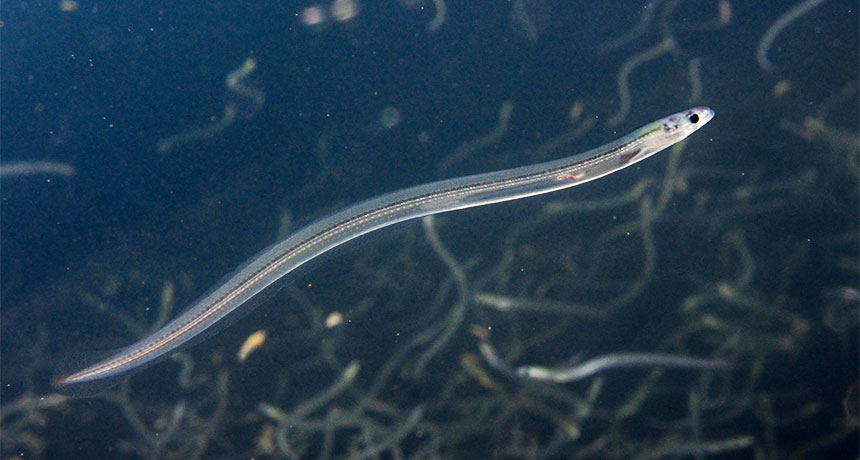
The Gulf Stream fast-tracks young European eels from their birthplace in the Sargasso Sea to the European rivers where they grow up. Eels can sense changes in Earth’s magnetic field to find those highways in a featureless expanse of ocean — even if it means swimming away from their ultimate destination at first, researchers report in the April 13 Current Biology.
European eels (Anguilla anguilla) mate and lay eggs in the salty waters of the Sargasso Sea, a seaweed-rich region in the North Atlantic Ocean. But the fish spend most of their adult lives living in freshwater rivers and estuaries in Europe and North Africa. Exactly how eels make their journey from seawater to freshwater has baffled scientists for more than a century, says Nathan Putman, a biologist with the National Oceanic and Atmospheric Administration in Miami.
The critters are hard to track. “They’re elusive,” says study coauthor Lewis Naisbett-Jones, a biologist now at the University of North Carolina at Chapel Hill. “They migrate at night and at depth. The only reason we know they spawn in the Sargasso Sea is because that’s where the smallest larvae have been collected.”
Some other marine animals, like sea turtles and salmon, tune in to subtle changes in Earth’s magnetic field to help them migrate long distances. To test whether eels might have the same ability, Putman and his colleagues placed young European eels in a 3,000-liter tank of saltwater surrounded by copper wires. Running electric current through the wires simulated the magnetic field experienced at different places on Earth. With no electric current, the eels didn’t swim in any particular direction. But when the magnetic field matched what eels would experience in the Sargasso Sea, the fish mostly swam to the southwest corner of their tank. That suggests the eels might use the magnetic field as a guide to help them move in a specific direction to leave their spawning grounds.
Swimming southwest from the Sargasso Sea seems counterintuitive for an eel trying to ultimately go northeast, Putman says. But computer simulations revealed that that particular bearing would push eels into the Gulf Stream, whisking them off to Europe. Catching a more circuitous ride on a current is probably more efficient for the eels than swimming directly across the North Atlantic, says Putman.
Magnetic fields could help eels stay the course, too. A magnetic field corresponding to a spot in the North Atlantic further along the eels’ route to Europe sent the eels in the tank heading northeast. That’s the direction they’d need to go to keep following the Gulf Stream to Europe.
The researchers did see a fair amount of variation in how strongly individual eels responded to magnetic fields. But that makes sense, says Julian Dodson, a biologist at Laval University in Quebec City who wasn’t part of the study. The Gulf Stream is such a powerful current that the eels could wriggle in a spread of directions to get swept up in its flow.
Now, the researchers are looking at whether adult eels use a similar magnetic map to get back to the Sargasso Sea. Adults follow a meandering return route that might take more than a year to complete, previous research suggests (SN Online: 10/5/16). But whether there’s some underlying force that guides them remains to be seen.